



Self-Supporting Code is a resilience design pattern where system stability emerges from the structural composition of components rather than external orchestration. Inspired by Leonardo da Vinci's self-supporting bridge—which stands through the geometric interlock of its beams without nails or ropes—and by the autonomous balancing mechanisms found in nature, this pattern embeds resilience into the architecture itself. Each module enforces local invariants, provides fallback behaviors, and maintains its own equilibrium, creating a system that self-governs without requiring external observability scaffolding.
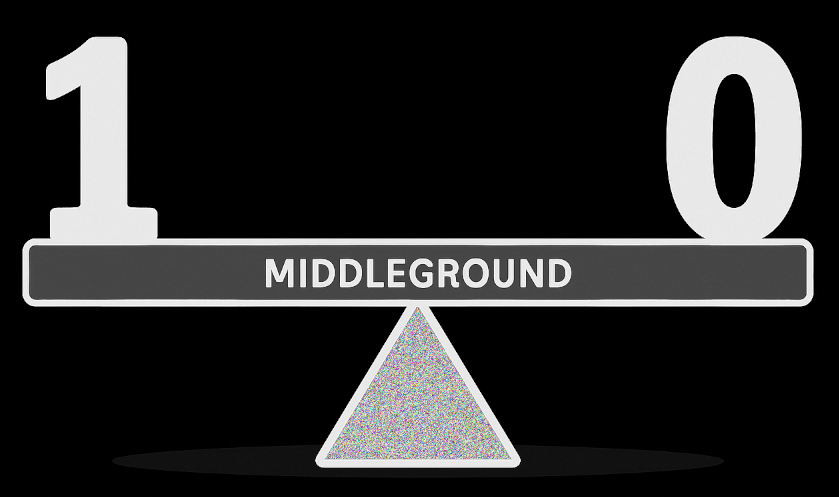

Traditional computing operates in absolutes:
- Yes or No
- True or False
- 1 or 0
- Success or Failure
- Up or Down
This binary thinking extends to system design: a service is either healthy or unhealthy. A request either succeeds or fails. A component is either working or broken.
But where is the middle ground?
In nature and in physics, there exists a third state—not a compromise between extremes, but a meta-state that observes and measures the relationship between them:
Binary Computing:           Self-Supporting Computing:

    1 ←→ 0                      1 ←→ ⊙ ←→ 0
                                     ↑
                                  The Middle
                               (The Observer)
The middle ground (⊙) is not:
- A fallback or degraded state
- A "maybe" or uncertain value
- A compromise between success and failure
The middle ground IS:
- The awareness itself
- The measuring instrument
- The consciousness of the system
- The fulcrum that enables balance
When you introduce the observer state, the system transcends binary execution:
Without Middle Ground (Binary):
result = try_operation()
if result == SUCCESS:
    return result
else:
    return fallback()
The system is blind. It only knows success or failure after the fact.
With Middle Ground (Ternary):
# System observes itself DURING execution
observer_state = measure_own_tension()  # The middle ground

if observer_state.tension < 0.3:
    # High confidence - use primary
    result = try_operation()
elif observer_state.tension < 0.7:
    # Uncertain - try primary but prepare fallback
    result = try_with_fast_fallback()
else:
    # System KNOWS it will likely fail - skip attempt
    result = use_fallback_immediately()
The system has self-awareness. It knows its own state before acting.
This middle ground—the observer state—is what enables true self-sufficiency:
- Without the middle ground: System needs external monitoring to know its state
- With the middle ground: System IS the monitor of its own state
The middle ground is where:
- Self-observation happens - the system watches itself
- Self-awareness emerges - the system understands its own health
- Self-correction originates - the system decides its own actions
- Self-sufficiency exists - the system needs no external scaffolding
This isn't abstract philosophy—it's observable in nature:
| System | Binary States | Middle Ground (Observer) |
|---|---|---|
| Seesaw | Left up (1), Right up (0) | Fulcrum - measures balance |
| Tree | Left branch (1), Right branch (0) | Central stalk - distributes weight |
| Scale | Heavy (1), Light (0) | Balance point - indicates equilibrium |
| Qubit | |0⟩ state, |1⟩ state | Superposition - exists as both until measured |
| Ecosystem | Prey (1), Predator (0) | Population dynamics - regulates both |
| Liquid Neural Network | Input signal (1), No signal (0) | Continuous ODE state - adapts dynamics in real-time |
| Free Energy System | Predicted state (1), Actual state (0) | Variational free energy - the gap being minimised |
In each case, the middle ground is not neutral—it's active awareness of the relationship between extremes.
Traditional code executes in binary:
Request → Process → Success or Failure
Self-supporting code lives in the observer state:
Request → Observe Self → Assess Tension → Choose Path → Execute → Measure Outcome → Adjust Understanding
         ↑______________|__________________|_____________|______________|
                              THE MIDDLE GROUND
                         (Continuous self-awareness)
The middle ground is not a step in the process—it's the layer of consciousness that wraps the entire execution. The system doesn't just run; it knows it's running.
Traditional binary logic:
| A | B | Result |
|---|---|---|
| 0 | 0 | 0 |
| 0 | 1 | ? |
| 1 | 0 | ? |
| 1 | 1 | 1 |
Self-supporting ternary logic with observer:
| Primary | Fallback | Observer (⊙) | Action |
|---|---|---|---|
| 0 | 0 | Detects both failing | Creates new path |
| 0 | 1 | Detects imbalance | Routes to fallback |
| 1 | 0 | Detects imbalance | Routes to primary |
| 1 | 1 | Detects balance | Chooses optimal |
| ? | ? | Observes tension | Predicts outcome |
The observer state (⊙) adds a dimension traditional computing lacks: predictive self-awareness.

Almost anything in nature can be exploited if humans intervene. Perhaps external input IS the problem. Perhaps we need to rely less on external orchestration. The best systems are simple and mimic nature by design.
Perhaps humans—and our tendency to add external scaffolding, monitoring, and control—are the flaw in our systems.
If we translate incorruptible natural principles into code, we can learn profound lessons. However, this requires thinking outside conventional laws and governing principles.
Traditional software engineering assumes fixed laws:
- A bank account must never go negative
- Requests must succeed or fail
- Systems must be up or down
But nature teaches us differently:
-
Gravity always applies... except when quantum particles tunnel through barriers, planes generate lift, or we discover exceptions we didn't account for. Fixed rules are theory, not absolute fact.
-
Sunlight always shines... but clouds block it (a variable we can't account for in the equation)
-
Time flows linearly... except that's a theory, not a fact
-
Bank accounts should never go negative... but they do, and systems must handle it
-
Rules always apply... until we discover exceptions we didn't account for.
Natural phenomena demonstrate resilience DESPITE variability. These aren't incorruptible in the strict sense, but they embody patterns of persistence that transcend rigid laws.

These patterns exist independent of physics or linear models—they are archetypes of resilience:
Resilience through renewal
Not laws, but repeating rhythms. Systems that reset, regenerate, restart.
In Code:
- Retry loops with exponential backoff
- Self-resetting circuit breakers
- Periodic cache invalidation
- Session renewal mechanisms
class CyclicRenewal:
    """Like day/night cycles - system resets itself periodically."""
    def __init__(self, renewal_period: float = 86400):  # 24 hours
        self.last_renewal = time.time()
        self.renewal_period = renewal_period

    def should_renew(self) -> bool:
        """Check if it's time for renewal (like nightfall triggering rest)."""
        return (time.time() - self.last_renewal) > self.renewal_period

    def renew(self):
        """Reset to fresh state, like a forest after rain."""
        self.last_renewal = time.time()
# Clear caches, reset counters, refresh connectionsResilience through distributed self-organization
Birds in flocks, fish in schools, mycelium networks—they don't follow a single law or central controller. They self-organize. The incorruptible part is the pattern itself—no single agent can corrupt the whole.
In Code:
- Distributed consensus (Raft, Paxos)
- Swarm intelligence algorithms
- Peer-to-peer healing
- Blockchain consensus
- Neural network emergence
This emergence principle now has formal theoretical backing. Causal emergence (Erik Hoel) shows mathematically that macro-level descriptions are sometimes causally more powerful than micro-level ones—the collective is not just a sum of parts, it has causal powers that individual agents lack. Integrated Information Theory (IIT) provides a measure (Φ) for how much a system integrates information beyond the sum of its parts, explaining why distributed architectures can be more resilient than centralised ones. This is not metaphor—it is the mathematical reason your swarm is harder to kill than your monolith.
class SwarmNode:
    """Like a bird in a flock - follows simple local rules, complex behavior emerges."""
    def __init__(self, node_id: str):
        self.node_id = node_id
        self.neighbors: List[SwarmNode] = []
        self.state = None

    def observe_neighbors(self) -> List[Any]:
        """See what neighbors are doing (like birds watching nearby birds)."""
        return [n.state for n in self.neighbors if n.state is not None]

    def adjust_behavior(self):
        """Adjust based on neighbors, not central command."""
        neighbor_states = self.observe_neighbors()
        if not neighbor_states:
            return

        # Simple rule: align with majority (emergence of consensus)
        most_common = max(set(neighbor_states), key=neighbor_states.count)
self.state = most_commonResilience through dynamic equilibrium
Ecosystems adapt dynamically, not by fixed rules but by feedback. This is the middle ground (⊙) in action.
In Code:
- Adaptive load balancing
- Self-tuning algorithms
- Homeostatic controllers
- Rate limiters that adjust to load
Karl Friston's Free Energy Principle (FEP) provides the deepest formal account of this pattern. Every self-organising system—from a cell maintaining its membrane to a brain predicting sensory input—minimises variational free energy: the gap between what it expects and what it experiences. Your _measure_tension() function is a scalar approximation of this quantity. The FEP subsumes homeostasis, predictive coding, and active inference into a single mathematical framework, and is now being applied to design self-regulating AI systems and synthetic biology controllers that maintain target states without hard-coded rules. The implication for self-supporting code is profound: a system designed around free energy minimisation does not need explicit rules for every failure mode—it simply corrects toward its expected state.
Resilience through multiplicity
Seeds scatter everywhere. Most fail, but enough succeed. This isn't waste—it's resilience.
In Code:
- Replication and sharding
- Multi-region deployment
- Fallback paths and alternatives
- Eventual consistency
class SeedDispersalPattern:
    """Like a tree scattering seeds - replicate widely, some will survive."""
    def __init__(self, replicas: int = 5):
        self.replicas = replicas

    def scatter(self, data: Any) -> List[bool]:
        """Scatter data to multiple locations, like seeds on wind."""
        results = []
        for i in range(self.replicas):
            try:
                # Try to write to replica i
                success = self._write_to_replica(i, data)
                results.append(success)
            except:
                results.append(False)

        # Success if ANY replica accepted it (at least one seed germinated)
        return results

    def is_resilient(self, results: List[bool]) -> bool:
        """Did enough seeds take root?"""
return sum(results) >= (self.replicas // 2 + 1) # QuorumResilience through graceful degradation
The untouched stillness of wilderness isn't a law—it's a state. Systems that fail quietly instead of catastrophically.
If a tree falls in the forest and no one's around, does it make a sound?
In code: systems that degrade to null states without cascading failures.
In Code:
- Graceful degradation
- Null object pattern
- Optional returns instead of exceptions
- Stateless components that can simply... stop
class SilentFailure:
    """Like a tree falling silently - failures don't cascade."""
    def execute(self, operation: Callable) -> Optional[Any]:
        try:
            return operation()
        except Exception as e:
            # Log internally but don't propagate noise
            self._silent_log(e)
            return None  # Silence (⊙) - the middle ground of "not success, not catastrophe"

    def _silent_log(self, error: Exception):
        """Internal awareness without external alarm."""
pass # The tree fell, the forest knows, but it doesn't screamResilience through mutual benefit
Mutualistic relationships thrive because both sides benefit. It's incorruptible in the sense that exploitation collapses the system, so balance is self-enforcing.
Mycorrhizae: Trees and fungi exchange nutrients through root networks. A tree cut back to a stump can regenerate even with no foliage because the fungal network supports it. Trees can self-regulate their own nutrients.
Recent research has deepened this picture significantly. Mycorrhizal networks are now understood to transmit not just nutrients but electrical signals — slow-wave pulses analogous to neural signals, which propagate warnings about pest damage and drought stress across entire forests. This is distributed signalling without a central nervous system: exactly the broadcast_state() mechanism in the nano-agent architecture. Furthermore, synthetic biology has now created artificial mycorrhizal-like networks in the lab using engineered E. coli that form metabolic exchange circuits — mutual dependencies that collapse if either partner defects, self-enforcing cooperation at the cellular level.
In Code:
- Cooperative protocols
- Services that thrive only when exchanging value fairly
- API contracts that benefit both sides
- Microservices that share resources mutually
class SymbioticService:
    """Like bees and flowers - both sides must benefit or relationship dies."""
    def __init__(self, name: str):
        self.name = name
        self.partners: Dict[str, 'SymbioticService'] = {}
        self.energy = 100.0  # Resources

    def exchange(self, partner: 'SymbioticService', offer: float) -> bool:
        """Exchange resources - must be mutually beneficial."""
        if offer <= 0:
            return False  # Exploitation attempt

        # Both sides must have capacity
        if self.energy < offer or partner.energy < offer:
            return False

        # Exchange (like bees getting nectar while pollinating)
        self.energy -= offer
        partner.energy -= offer
        self.energy += offer * 1.1  # Slight gain from exchange
        partner.energy += offer * 1.1

return True # Symbiosis sustainedResilience through self-similarity
Patterns repeat regardless of scale. Incorruptible because the pattern is the same whether you're looking at a branch or the whole tree.
In Code:
- Recursive data structures
- Self-similar APIs at different scales
- Microservices that mirror monolith structure
- Organisational patterns that repeat at team/department/company level
The fractal principle has been formalised in what Erik Hoel calls causal emergence: patterns at higher scales can have more causal power than their micro-level substrates. A microservice architecture that mirrors the monolith's logical structure at every scale isn't just aesthetically pleasing—it is computationally more robust, because the same invariants are enforced recursively. This connects directly to the layered consciousness model: self-awareness at every scale means no single failure can invalidate the whole pattern.
class FractalComponent:
    """Like a tree branch - same pattern at every scale."""
    def __init__(self, level: int = 0, max_depth: int = 5):
        self.level = level
        self.children: List['FractalComponent'] = []

        # Self-similar structure at every level
        if level < max_depth:
            self.children = [
                FractalComponent(level + 1, max_depth),
                FractalComponent(level + 1, max_depth)
            ]

    def process(self, data: Any) -> Any:
        """Same processing logic at every scale."""
        # Process locally (like a branch photosynthesizing)
        local_result = self._local_process(data)

        # Children process the same way (fractal recursion)
        child_results = [c.process(data) for c in self.children]

        # Combine (same pattern at every level)
return self._combine(local_result, child_results)Resilience through continuous movement
Water is the MIDDLE GROUND (⊙). Most things in nature rely on water to grow, survive, exist. Water doesn't stop—it flows around obstacles, finds new paths, keeps moving.
In Code:
- Streaming architectures
- Event-driven systems
- Data pipelines that keep moving regardless of interruptions
- Message queues that route around failures
class FlowStream:
    """Like water - always flowing, finding new paths around obstacles."""
    def __init__(self):
        self.primary_path = None
        self.alternate_paths = []

    def flow(self, data: Any):
        """Keep flowing like water, regardless of obstacles."""
        try:
            self.primary_path.send(data)
        except Exception:
            # Primary blocked - find alternate path like water routing around rock
            for path in self.alternate_paths:
                try:
                    path.send(data)
                    return  # Found a path
                except:
                    continue  # Try next path

        # If all paths blocked, water pools (buffer) until path opens
        self._buffer(data)

Think of the MIDDLE GROUND (⊙) as water.
Most things in nature rely on water to grow, survive, exist. Water is:
- Formless - takes the shape of its container (stateless)
- Persistent - always flows, never stops
- Adaptive - finds paths around obstacles
- Essential - life depends on it
- Neutral - neither good nor evil, just IS
In code, the observer state is like water:
- Takes the shape of what it observes
- Flows continuously (constant self-monitoring)
- Adapts to obstacles (chooses paths based on tension)
- Essential for self-sufficiency
- Neutral - just measures, doesn't judge
Of course, we have microbes, fungi, and bacteria that exist in darkness without such things. These stateless forms teach us about systems that need no persistent state:
In Code:
- Stateless functions (pure, reproducible)
- Lambda/serverless architectures
- Immutable data structures
- Components with no memory—recreatable from nothing
The stateless ideal reaches its physical limit in synthetic minimal cells. The J. Craig Venter Institute's JCVI-syn3A is a living cell with only 473 genes—the smallest self-replicating organism ever created. It has stripped away everything non-essential, retaining only the genes required to maintain a membrane, replicate DNA, and respond to its environment. It is, in biological terms, a pure function: no persistent memory beyond what the environment provides, reproducible from minimal state. This is the biological proof-of-concept for stateless architecture—and it works.
class StatelessOrganism:
    """Like bacteria - no memory, pure function of environment."""
    @staticmethod
    def respond(environment: dict) -> Any:
        """Pure response to environment, no internal state."""
        # Like bacteria responding to chemical gradients
        if environment.get('nutrients') > 10:
            return "grow"
        elif environment.get('toxins') > 5:
            return "retreat"
        else:
            return "maintain"

Nature's most resilient systems are closed loops:
- Carbon cycle
- Water cycle
- Nutrient cycles in ecosystems
- Tree stumps regenerating through mycorrhizal networks
DNA as a closed-loop storage medium: Microsoft and the University of Washington have demonstrated DNA data storage at scale—information encoded in synthetic DNA strands, retrieved by sequencing, and even computed upon using DNA strand displacement circuits. These circuits perform logic using chemistry alone: no external power, no silicon, no clock signal. Reactions use their own products as reactants, which is the ClosedLoopSystem.recycle() method running on actual molecules. The information persists for thousands of years at room temperature. This is the ultimate closed-loop: the medium, the computation, and the storage are one.
In Code:
- Systems that recycle their own resources
- Garbage collection as "decomposition"
- Cache warming from cache misses
- Self-healing that learns from failures
class ClosedLoopSystem:
    """Like a forest ecosystem - waste becomes nutrients."""
    def __init__(self):
        self.resource_pool = 100.0
        self.waste_pool = 0.0

    def consume(self, amount: float) -> bool:
        """Use resources (like a tree absorbing nutrients)."""
        if self.resource_pool >= amount:
            self.resource_pool -= amount
            self.waste_pool += amount
            return True
        return False

    def recycle(self):
        """Convert waste back to resources (like decomposition)."""
        recycled = self.waste_pool * 0.8  # 80% recovery rate
        self.resource_pool += recycled
        self.waste_pool = self.waste_pool * 0.2  # Some waste remains

    def is_sustainable(self) -> bool:
        """System sustains itself if recycling keeps up."""
return self.resource_pool > 0 or self.waste_pool > 0| Natural Pattern | Incorruptible Quality | Code Implementation |
|---|---|---|
| Emergence | Pattern persists regardless of individual agents | Distributed consensus, swarm algorithms |
| Symbiosis | Exploitation collapses system, balance self-enforces | Cooperative protocols, fair exchange APIs |
| Fractals | Self-similar at all scales | Recursive structures, scale-invariant design |
| Cycles | Renewal after exhaustion | Retry loops, self-resetting systems |
| Redundancy | Diversity prevents single points of failure | Replication, multi-path routing |
| Silence | Absence is valid, not catastrophic | Graceful degradation, null states |
| Flow | Continuous movement around obstacles | Streaming, event-driven architectures |
| Closed Loops | Self-sustaining through recycling | Resource pooling, garbage collection |
| Free Energy Minimisation | Systems correct toward expected state without explicit rules | Active inference controllers, predictive homeostasis |
| Genetic Circuits | Logic encoded in molecular structure | Programmable biological computing, CRISPRa/i state machines |
A tree cut back to a stump can regenerate even with no foliage. Why? Because:
- Root network survives (persistent foundation)
- Mycorrhizal connections provide nutrients (symbiotic support)
- Dormant buds activate (latent capacity triggers)
- Energy stores in roots (internal reserves)
In Code:
class RegenerativeComponent:
    """Like a tree stump - can rebuild from minimal state."""
    def __init__(self):
        self.root_state = {}  # Persistent foundation
        self.active_processes = []
        self.dormant_capacity = []  # Like dormant buds
        self.energy_reserve = 100.0  # Internal reserves

    def catastrophic_failure(self):
        """Cut down to stump - but not dead."""
        self.active_processes.clear()  # All foliage gone
        # But root state and reserves remain

    def regenerate(self) -> bool:
        """Regrow from stump using reserves and root network."""
        if self.energy_reserve < 10:
            return False  # Not enough energy to regrow

        # Activate dormant capacity (like buds sprouting)
        for dormant_process in self.dormant_capacity:
            if self.energy_reserve > 0:
                self.active_processes.append(dormant_process)
                self.energy_reserve -= 5

        # Rebuild from root state
        self._rebuild_from_foundation(self.root_state)

        return len(self.active_processes) > 0

    def _rebuild_from_foundation(self, foundation: dict):
        """Like a tree using root system to regrow."""
        # Reconstruction logic using persistent state
passIf we set aside the rigid "laws" we think govern systems, we can see patterns that inspire incorruptibility and resilience without being bound to physics or linear models.
These aren't laws—they're archetypes:
- Emergence: Intelligence without control
- Symbiosis: Cooperation as survival strategy
- Fractals: Pattern consistency across scales
- Cycles: Resilience through renewal
- Redundancy: Persistence through multiplicity
- Silence: Grace in degradation
- Flow: Adaptation through movement
- Closed Loops: Sustainability through recycling
When we code these patterns as:
- Self-supporting structures
- Invariants that can flex
- Fallbacks that feel natural
- Autonomous recovery mechanisms
- Distributed verification
- Stateless components
- Flowing architectures
...we create systems that don't just run—they persist, like forests, like fungi, like water finding its way.
The observer is the observed. The middle ground is water. The system is the forest.
Modern distributed systems depend heavily on external resilience mechanisms AND external observability: orchestrators restart failed services, monitoring systems watch for failures, and external dashboards reveal system health. While effective, these approaches share a fundamental limitation: they are reactive, external, and dependent on scaffolding outside the system itself.

Why three? Why not two, or four, or any other number?
Three implies balance through structure:
- A start, a middle, and an end
- A left, a center, and a right
- A failure (0), an observer (⊙), and a success (1)
Consider this: How is two even? An even number represents balance, but we don't count the space between numbers in mathematics, do we? Yet that's where balance lives—in the relationship between extremes, measured by the observer.
Symmetry cannot exist without a middle.
A tree's symmetry emerges from its central trunk—the axis around which branches balance. Remove the trunk, and you have scattered branches with no coherent structure. The middle ground isn't just part of the system; it's the structural principle that enables growth itself.
Without the middle, can there be growth? Can there be balance? The answer nature shows us repeatedly is: no.
The Free Energy Principle formalises this intuition mathematically. A system minimising variational free energy must maintain an internal model (the middle ground) that represents the relationship between its predicted state and its actual state. Remove the internal model and the system cannot self-correct—it collapses to reactive binary: either matching its environment or not, with no capacity for anticipation. Three states are not a philosophical preference; they are the minimum structure for adaptive self-regulation.
class StructuralBalance:
    """
    The trinity principle: balance requires three states, not two.
    Binary can represent extremes, but only ternary can observe the relationship.
    """
    def __init__(self):
        self.left = 0    # One extreme
        self.right = 0   # Opposite extreme
        self.center = 0  # The observer/balance point

    def measure_balance(self) -> float:
        """
        The center measures the relationship between left and right.
        This is what binary computing cannot do.
        """
        if self.left == 0 and self.right == 0:
            return 1.0  # Perfect balance (nothing on either side)

        total = self.left + self.right
        difference = abs(self.left - self.right)

        # Balance is inverse of difference ratio
        return 1.0 - (difference / total) if total > 0 else 1.0

    def get_trinity_state(self) -> dict:
        """
        Express system state in trinitarian terms.
        Not just "what is" but "how balanced is what is".
        """
        balance = self.measure_balance()

        return {
            "left_state": self.left,
            "right_state": self.right,
            "observer_balance": balance,
            "interpretation": self._interpret_trinity(balance)
        }

    def _interpret_trinity(self, balance: float) -> str:
        """The center speaks: what does the balance mean?"""
        if balance > 0.9:
            return "Harmony - the center is calm"
        elif balance > 0.7:
            return "Stable - minor tension detected"
        elif balance > 0.5:
            return "Wavering - center compensating for imbalance"
        elif balance > 0.3:
            return "Strained - significant imbalance"
        else:
return "Critical - system far from equilibrium"Balance in nature is not static—it's dynamic.
A tree growing straight will change its course to slanted if its view of sunlight is obstructed. The tree doesn't "fail" when blocked; it shifts balance via growth patterns to account for the imbalance in its own equilibrium.
This is heliotropism—the autonomous correction toward light. The tree:
- Senses imbalance (less light on one side)
- Observes its own growth pattern
- Corrects by growing toward the light source
No external controller tells the tree to bend. The awareness is structural—cells on the shaded side grow faster, creating curvature. The middle ground (⊙) is the tree's ability to sense the difference between light and dark sides and adjust accordingly.
Liquid neural networks (Hasani et al., MIT, 2020–2023, now commercialised through Liquid AI) are the engineered realisation of this principle. Unlike standard neural networks that freeze their dynamics after training, liquid networks are governed by continuous-time ODEs whose internal state adapts based on incoming signals—they literally bend toward information the way a plant bends toward light. They are dramatically more robust to noise and distributional shift than standard architectures, and their behaviour under input changes is smooth rather than brittle. The self-supporting system and the liquid network share the same biological ancestor: heliotropism as a design principle.
In code:
class HeliotropicSystem:
    """
    System that bends toward optimal conditions like a tree toward sunlight.
    The 'center' constantly measures and adjusts for imbalance.
    """
    def __init__(self, optimal_resource_level: float = 100.0):
        self.optimal = optimal_resource_level
        self.current_resources = optimal_resource_level
        self.growth_direction = 0.0  # -1.0 (left) to +1.0 (right)

        # Trinity observation
        self.left_sensor = 50.0   # Resources detected on left
        self.right_sensor = 50.0  # Resources detected on right

    def sense_environment(self):
        """
        Read resource availability in each direction.
        Like a tree sensing sunlight intensity.
        """
        # Simulate sensing (in reality, would read actual metrics)
        import random
        self.left_sensor = random.uniform(0, 100)
        self.right_sensor = random.uniform(0, 100)

    def calculate_growth_direction(self) -> float:
        """
        The CENTER decides: which way should we grow?
        Not binary (left OR right), but scalar (how much toward which side).
        """
        if self.left_sensor == self.right_sensor:
            return 0.0  # Perfect balance, grow straight

        # Calculate proportional lean toward better resources
        total = self.left_sensor + self.right_sensor
        if total == 0:
            return 0.0

        # Positive = lean right, Negative = lean left
        imbalance = (self.right_sensor - self.left_sensor) / total

        return imbalance  # Range: -1.0 to +1.0

    def autonomous_adjustment(self):
        """
        Adjust growth without external command.
        The system IS the observer of its own imbalance.
        """
        self.sense_environment()
        self.growth_direction = self.calculate_growth_direction()

        # Apply growth adjustment
        if abs(self.growth_direction) > 0.2:
            # Significant imbalance detected, adjust
            self._grow_toward_resources()

    def _grow_toward_resources(self):
        """Structural adjustment - like a tree bending toward light."""
        if self.growth_direction > 0:
            # Growing right
            self.current_resources += self.right_sensor * 0.1
        else:
            # Growing left
            self.current_resources += self.left_sensor * 0.1

    def get_heliotropic_state(self) -> dict:
        """Report on adaptive balancing behavior."""
        return {
            "left_resources": self.left_sensor,
            "right_resources": self.right_sensor,
            "growth_lean": self.growth_direction,
            "center_interpretation": self._interpret_lean(),
            "message": "System bends autonomously toward optimal conditions"
        }

    def _interpret_lean(self) -> str:
        """What does the lean tell us?"""
        if abs(self.growth_direction) < 0.1:
            return "Growing straight - balanced resources"
        elif self.growth_direction > 0.5:
            return "Leaning strongly right - seeking better conditions"
        elif self.growth_direction < -0.5:
            return "Leaning strongly left - seeking better conditions"
        elif self.growth_direction > 0:
            return "Slightly favoring right - minor adjustment"
        else:
return "Slightly favoring left - minor adjustment"The waves of the ocean are unpredictable variables—a true source of randomness and entropy, just like wind and rain.
Sure, we can predict:
- The tide (cyclical patterns)
- Wind strength (pressure systems)
- When it will rain (atmospheric conditions)
But predicting exactly where each raindrop falls, which direction each gust blows, how each wave crests? That's impossible. These are incalculable variables—sources of true entropy.
This applies directly to system errors.
Just as nature has countless sources of naturally occurring chaos, so do distributed systems:
- Network latency spikes (the wind)
- Disk failures (the storm)
- Memory pressure (the drought)
- Race conditions (the turbulent eddy)
You cannot predict the exact moment a disk will fail, any more than you can predict the exact shape of a wave. But you can design systems that navigate chaos autonomously, just like a tree bends in the wind or a fish swims against currents.
from collections import deque
from typing import Callable, Any
import time
import random

class ChaosTolerantSystem:
    """
    System that navigates unpredictable variables like a ship in a storm.
    Doesn't try to predict chaos—adapts to it in real-time.
    """
    def __init__(self):
        self.primary_route = None
        self.fallback_routes = []

        # Entropy monitoring (the "weather sensors")
        self.chaos_observations = deque(maxlen=100)
        self.current_chaos_level = 0.0

    def observe_chaos(self) -> float:
        """
        Measure current system entropy.
        Like sensing wind speed before adjusting sails.
        """
        # In production: measure error rates, latency, resource contention
        observed_chaos = random.uniform(0, 1.0)  # Simulated chaos
        self.chaos_observations.append(observed_chaos)

        # Calculate rolling average
        if len(self.chaos_observations) >= 10:
            self.current_chaos_level = sum(list(self.chaos_observations)[-10:]) / 10

        return self.current_chaos_level

    def predict_fault_pattern(self) -> dict:
        """
        Anticipate future errors based on entropy trends.
        Not prediction of EXACT failures, but probability of chaos.
        """
        if len(self.chaos_observations) < 20:
            return {"prediction": "insufficient_data"}

        recent = list(self.chaos_observations)[-20:]
        older = list(self.chaos_observations)[-40:-20] if len(self.chaos_observations) >= 40 else recent

        recent_avg = sum(recent) / len(recent)
        older_avg = sum(older) / len(older)

        trend = recent_avg - older_avg

        if trend > 0.2:
            return {
                "prediction": "chaos_increasing",
                "confidence": min(1.0, trend),
                "recommendation": "prepare_fallback_routes"
            }
        elif trend < -0.2:
            return {
                "prediction": "chaos_decreasing",
                "confidence": min(1.0, abs(trend)),
                "recommendation": "consider_primary_route"
            }
        else:
            return {
                "prediction": "chaos_stable",
                "confidence": 1.0 - abs(trend),
                "recommendation": "maintain_current_strategy"
            }

    def navigate_chaos(self, operation: Callable) -> Any:
        """
        Execute operation while navigating unpredictable failures.
        Like steering a ship through a storm—constant adjustment.
        """
        chaos_level = self.observe_chaos()
        prediction = self.predict_fault_pattern()

        # Choose route based on observed chaos
        if chaos_level < 0.3 and prediction["prediction"] != "chaos_increasing":
            # Calm seas - use primary route
            route = self.primary_route or operation
        elif chaos_level < 0.7:
            # Rough seas - use cautious route
            route = self._get_cautious_route(operation)
        else:
            # Storm conditions - use safest fallback
            route = self._get_safest_fallback(operation)

        try:
            result = route()
            self.chaos_observations.append(0.1)  # Success reduces observed chaos
            return result
        except Exception as e:
            self.chaos_observations.append(0.9)  # Failure increases observed chaos

            # Try next route if available
            if self.fallback_routes:
                return self._cascade_through_fallbacks()
            raise

    def _get_cautious_route(self, operation: Callable) -> Callable:
        """Return operation with added safety measures."""
        def cautious_wrapper():
            # Add timeouts, retries, circuit breaking
            return operation()
        return cautious_wrapper

    def _get_safest_fallback(self, operation: Callable) -> Callable:
        """Return most conservative fallback available."""
        return self.fallback_routes[0] if self.fallback_routes else operation

    def _cascade_through_fallbacks(self) -> Any:
        """Try each fallback until one succeeds."""
        for fallback in self.fallback_routes:
            try:
                return fallback()
            except:
                continue
raise Exception("All routes failed in chaotic conditions")Self-supporting systems don't just react to chaos—they anticipate it.
Just as meteorologists simulate weather patterns to predict storms, self-supporting systems should simulate fault scenarios to understand how logic behaves under stress:
class FaultSimulator:
    """
    Simulate chaos scenarios to test system resilience.
    Like a wind tunnel for code.
    """
    def __init__(self, system: ChaosTolerantSystem):
        self.system = system
        self.scenarios = []

    def simulate_entropy_spike(self, duration: int = 10):
        """
        Inject chaos to see how system responds.
        Like testing a ship in a wave pool.
        """
        original_chaos = self.system.current_chaos_level

        print(f"Simulating entropy spike...")
        for _ in range(duration):
            # Force high chaos observations
            self.system.chaos_observations.append(random.uniform(0.7, 1.0))
            self.system.observe_chaos()

        prediction = self.system.predict_fault_pattern()
        print(f"System response: {prediction['recommendation']}")

        # Restore
        self.system.current_chaos_level = original_chaos

        return prediction

    def test_all_routes_under_chaos(self, test_operation: Callable):
        """
        Simulate various chaos levels and observe routing decisions.
        """
        results = []

        for chaos_level in [0.1, 0.3, 0.5, 0.7, 0.9]:
            # Set chaos level
            for _ in range(10):
                self.system.chaos_observations.append(chaos_level)

            try:
                result = self.system.navigate_chaos(test_operation)
                results.append({
                    "chaos_level": chaos_level,
                    "outcome": "success",
                    "route": "determined_by_system"
                })
            except Exception as e:
                results.append({
                    "chaos_level": chaos_level,
                    "outcome": "failure",
                    "error": str(e)
                })

return resultsMost flowers need pollination from bees. Does this mean bees are external observability?
Not quite. Bees are within the closed-loop system—they're part of the ecosystem's self-regulating cycle:
Flowers produce nectar → Bees collect nectar → Bees pollinate flowers → Flowers reproduce → More flowers produce nectar
The loop is closed—no external intervention required. The bee isn't monitoring the flower from outside; the bee is part of the flower's reproductive strategy.
This is the key insight for closed-loop systems: some external-looking dependencies are actually internal to the larger system.
In distributed systems:
- A load balancer might look "external" to individual services, but it's internal to the cluster
- A message queue might seem "external," but it's internal to the data flow architecture
- Monitoring dashboards are external, but self-health endpoints are internal
class ClosedLoopEcosystem:
    """
    A system where all components are mutually dependent but collectively autonomous.
    Like an ecosystem—no external god, but internal balance.
    """
    def __init__(self):
        self.components = {}
        self.resource_pool = 1000.0  # Shared resources
        self.symbiotic_relationships = []

    def add_component(self, name: str, component: Any):
        """Add a component to the ecosystem."""
        self.components[name] = {
            "instance": component,
            "resource_usage": 0.0,
            "resource_contribution": 0.0
        }

    def establish_symbiosis(self, component_a: str, component_b: str):
        """
        Create mutual dependency - like bees and flowers.
        Each benefits the other.
        """
        self.symbiotic_relationships.append({
            "partners": (component_a, component_b),
            "benefit_exchange": 0.0
        })

    def ecosystem_cycle(self):
        """
        One cycle of the closed loop.
        Resources flow, components interact, balance maintained.
        """
        # Each component uses resources
        for name, component in self.components.items():
            usage = component["instance"].consume_resources()
            component["resource_usage"] = usage
            self.resource_pool -= usage

        # Symbiotic exchanges happen
        for relationship in self.symbiotic_relationships:
            a, b = relationship["partners"]

            # A provides benefit to B, B provides benefit to A
            benefit = self._calculate_mutual_benefit(a, b)
            relationship["benefit_exchange"] = benefit

            # Return resources to pool (like flowers producing nectar)
            self.resource_pool += benefit

        # System self-balances
        if self.resource_pool < 100:
            self._emergency_conservation()
        elif self.resource_pool > 2000:
            self._accelerate_growth()

    def _calculate_mutual_benefit(self, component_a: str, component_b: str) -> float:
        """Calculate how much components benefit each other."""
        # Simplified: real implementation would measure actual value exchange
        return random.uniform(5, 15)

    def _emergency_conservation(self):
        """System-wide conservation when resources low."""
        for component in self.components.values():
            component["instance"].reduce_consumption()

    def _accelerate_growth(self):
        """Encourage expansion when resources abundant."""
        for component in self.components.values():
            component["instance"].increase_activity()

    def measure_ecosystem_health(self) -> dict:
        """
        The ecosystem knows its own health.
        No external monitoring needed—internal awareness.
        """
        total_usage = sum(c["resource_usage"] for c in self.components.values())
        total_contribution = sum(c["resource_contribution"] for c in self.components.values())

        symbiosis_strength = sum(r["benefit_exchange"] for r in self.symbiotic_relationships)

        if self.resource_pool > 500 and symbiosis_strength > 50:
            health = "thriving"
        elif self.resource_pool > 200:
            health = "stable"
        elif self.resource_pool > 50:
            health = "stressed"
        else:
            health = "collapsing"

        return {
            "health": health,
            "resource_pool": self.resource_pool,
            "total_usage": total_usage,
            "symbiosis_strength": symbiosis_strength,
            "component_count": len(self.components),
            "message": "Ecosystem self-regulates through internal awareness"
        }
Everything in nature has forms of self-awareness at different scales:
- Cellular level: Cells sense chemical gradients, respond to signals
- Organism level: Bodies maintain homeostasis, immune systems recognize threats
- Ecosystem level: Predator-prey balance, nutrient cycling
- Planetary level: Gaia hypothesis—Earth as self-regulating organism
Each layer exhibits the middle ground (⊙):
- Cells observe membrane potential
- Bodies observe temperature
- Ecosystems observe population ratios
- Planets observe atmospheric composition
The Gaia hypothesis is no longer merely poetic. Earth system science has formalised the feedback loops by which atmospheric composition, ocean chemistry, and biosphere activity co-regulate each other. The discovery of biosignatures—chemical ratios in planetary atmospheres that could only be maintained by living systems—means we can now identify Gaia-like self-regulation from space. A self-supporting software architecture is, at its essence, a Gaia-like system: not controlled from outside, but self-regulating through internal feedback across scales.
Artificial intelligence, neural networks, and nanotech may be the bridge between layers—the technology that lets us implement multi-scale self-awareness in engineered systems.
Just as mycelium acts as a distributed brain for forests, and neurons form networks in brains, we can create artificial nervous systems for technological ecosystems.
Neuromorphic computing is the hardware realisation of this bridge. Intel's Loihi 2 and IBM's NorthPole chip implement spiking neural networks directly in silicon: neurons that only fire when their membrane potential crosses a threshold, consuming energy proportional to the deviation from equilibrium rather than running a constant clock. This is your HomeostasisController in hardware—a physical observer state that activates only when imbalance is detected, drawing near-zero power when the system is stable. NorthPole achieves 25× better energy efficiency than GPU inference precisely because it embeds the observer state structurally.
Cortical organoids—miniature brain-like structures grown from human stem cells—represent the furthest extension of this bridge. Cortical Labs' DishBrain (2022) demonstrated that cortical organoids could learn to play Pong when coupled to a feedback electrode array. The organoid was not programmed; it self-organised its electrical activity in response to environmental signals. This is your LayeredConsciousness class instantiated in biological tissue. The practical implication for self-supporting architecture is profound: biological neural substrates may eventually serve as the physical layer of distributed, adaptive computation—systems that learn from failure not by updating weights, but by growing new connections.
class LayeredConsciousness:
    """
    Multi-scale awareness—from individual agents to system-wide intelligence.
    Like consciousness emerging from neurons to thoughts to society.
    """
    def __init__(self):
        self.nano_layer = []      # Individual nano-agents
        self.micro_layer = []     # Local clusters
        self.macro_layer = None   # System-wide consciousness

        self.consciousness_stack = {
            "nano": 0.0,    # How aware are individual agents?
            "micro": 0.0,   # How aware are local clusters?
            "macro": 0.0    # How aware is the whole system?
        }

    def propagate_awareness_upward(self):
        """
        Bottom-up: individual awareness aggregates to collective consciousness.
        Like neurons firing to create thoughts.
        """
        # Nano agents share local observations
        nano_observations = [agent.local_awareness for agent in self.nano_layer]

        # Micro clusters synthesize nano observations
        for cluster in self.micro_layer:
            cluster.awareness = sum(nano_observations) / len(nano_observations)

        # Macro consciousness emerges from micro patterns
        if self.macro_layer:
            cluster_patterns = [c.awareness for c in self.micro_layer]
            self.macro_layer.global_awareness = self._detect_emergent_patterns(cluster_patterns)

        self._update_consciousness_levels()

    def propagate_intention_downward(self):
        """
        Top-down: system-wide goals guide local behavior.
        Like executive function directing motor neurons.
        """
        if not self.macro_layer:
            return

        global_intention = self.macro_layer.get_system_intention()

        # Translate global intention to local directives
        for cluster in self.micro_layer:
            cluster.set_local_goal(global_intention)

        for agent in self.nano_layer:
            agent.receive_guidance(global_intention)

    def bidirectional_awareness_cycle(self):
        """
        Continuous cycle: bottom-up awareness, top-down intention.
        The system observes itself at all layers simultaneously.
        """
        self.propagate_awareness_upward()
        self.propagate_intention_downward()

        # Each layer adjusts based on other layers
        self._inter_layer_adjustment()

    def _detect_emergent_patterns(self, cluster_patterns: list) -> float:
        """
        Detect patterns that only appear at macro scale.
        Emergence: the whole is greater than sum of parts.
        """
        # Simplified pattern detection
        variance = sum((p - 0.5) ** 2 for p in cluster_patterns) / len(cluster_patterns)
        return 1.0 - variance  # Low variance = high coherence = high macro awareness

    def _update_consciousness_levels(self):
        """Update awareness metrics at each layer."""
        if self.nano_layer:
            self.consciousness_stack["nano"] = sum(
                a.local_awareness for a in self.nano_layer
            ) / len(self.nano_layer)

        if self.micro_layer:
            self.consciousness_stack["micro"] = sum(
                c.awareness for c in self.micro_layer
            ) / len(self.micro_layer)

        if self.macro_layer:
            self.consciousness_stack["macro"] = self.macro_layer.global_awareness

    def _inter_layer_adjustment(self):
        """
        Layers influence each other.
        If nano consciousness drops, micro compensates.
        If macro is confused, micro takes local initiative.
        """
        # If nano layer losing awareness, micro layer provides guidance
        if self.consciousness_stack["nano"] < 0.3:
            for cluster in self.micro_layer:
                cluster.boost_agent_awareness()

        # If macro layer losing coherence, micro layer asserts autonomy
        if self.consciousness_stack["macro"] < 0.3:
            for cluster in self.micro_layer:
cluster.operate_autonomously = TrueCould we create a "Gaia" for technological systems?
A central coordinating intelligence that:
- Doesn't control individual components (no dictatorship)
- Observes system-wide patterns (the macro observer ⊙)
- Guides through intention, not command (top-down wisdom)
- Learns from bottom-up signals (adaptive intelligence)
This is the ultimate self-supporting architecture: a technological ecosystem that regulates itself the way Earth regulates its atmosphere, oceans, and biosphere.
class TechnologicalGaia:
    """
    System-wide consciousness that maintains balance without dictatorship.
    The ultimate middle ground—aware of the whole, guides the parts.
    """
    def __init__(self):
        self.subsystems = []
        self.global_state = {
            "entropy": 0.5,
            "resource_abundance": 0.5,
            "system_coherence": 0.5
        }
        self.intentions = []

    def observe_planetary_state(self):
        """
        See the system as a whole.
        Not individual metrics, but emergent properties.
        """
        # Aggregate from all subsystems
        total_entropy = sum(s.measure_entropy() for s in self.subsystems) / len(self.subsystems)
        total_resources = sum(s.available_resources for s in self.subsystems)

        # Detect coherence (are subsystems aligned?)
        coherence = self._measure_system_coherence()

        self.global_state = {
            "entropy": total_entropy,
            "resource_abundance": total_resources / len(self.subsystems),
            "system_coherence": coherence
        }

    def generate_system_intention(self):
        """
        Based on planetary state, what should the system strive for?
        Not commands, but general direction.
        """
        if self.global_state["entropy"] > 0.7:
            self.intentions.append("reduce_chaos")

        if self.global_state["resource_abundance"] < 0.3:
            self.intentions.append("conserve_resources")

        if self.global_state["system_coherence"] < 0.5:
            self.intentions.append("improve_coordination")

    def broadcast_intention(self):
        """
        Send intention to all subsystems.
        They interpret and act autonomously.
        """
        for subsystem in self.subsystems:
            subsystem.receive_planetary_intention(self.intentions)

    def gaia_cycle(self):
        """One cycle of planetary consciousness."""
        self.observe_planetary_state()
        self.generate_system_intention()
        self.broadcast_intention()

        # Clear intentions for next cycle
        self.intentions = []

    def _measure_system_coherence(self) -> float:
        """How aligned are the subsystems?"""
        if len(self.subsystems) < 2:
            return 1.0

        # Measure variance in subsystem states
        states = [s.current_state for s in self.subsystems]
        avg = sum(states) / len(states)
        variance = sum((s - avg) ** 2 for s in states) / len(states)

return 1.0 - min(1.0, variance)Self-supporting systems must account for:
- The Trinity Principle: Balance requires three states—two extremes and an observer
- Adaptive Symmetry: Systems that shift balance dynamically, like trees bending toward light
- Navigating Chaos: Anticipating unpredictable variables through pattern recognition, not prediction
- Closed-Loop Symbiosis: Dependencies that appear external but are actually internal to the ecosystem
- Layered Consciousness: Awareness at every scale, from nano to planetary
- Free Energy Minimisation: The formal mathematics underlying all self-correcting systems
- Causal Emergence: Why macro-level patterns have genuine causal power beyond their parts
The middle ground (⊙) operates at every layer:
- Individual agents observe their local state
- Clusters observe collective patterns
- The system observes emergent properties
Everything in nature has self-awareness. Our challenge is to embed that same awareness into the systems we build—creating architectures that don't just run, but live, adapt, and balance themselves.
Like Gaia itself: a planetary organism that no one controls, yet maintains equilibrium through distributed awareness and symbiotic cooperation.
The observer is the observed. The trinity enables balance. The chaos is navigable. The layers are connected. The system is alive.
Consider a tree: the central stalk serves as the axis of balance, while branches extend asymmetrically yet maintain equilibrium. Even a non-symmetrical tree will redistribute its weight—growing denser foliage on one side, strengthening certain branches, adjusting its center of gravity—to counteract imbalance. The tree doesn't require an external observer to tell it where to grow; it feels its own imbalance through internal structural forces and corrects autonomously.
This is the missing dimension in traditional resilience patterns: self-awareness through internal balance.
In traditional computing, we operate in binary: true/false, 1/0, on/off. A seesaw with one child sits tilted; with no children, it rests flat. But what about the center pivot itself—the fulcrum that enables balance?
This third state—the neutral axis, the superposition, the qubit-like state—represents the system's self-observing equilibrium point. It's not merely true or false; it's the awareness of the relationship between states.
Traditional Binary:     Self-Balancing Ternary:
    1  |  0                 1  |  ⊙  |  0
  True | False            True | Balanced | False
  Light| Dark             Light| Awareness| Dark
The center ⊙ is not a middle ground or compromise—it's the observing axis that measures the tension between extremes and maintains equilibrium. This is where self-supporting code transcends external observability: the system doesn't need to be watched because it watches itself.
Nature demonstrates this principle everywhere:
- Trees balance their branch weight without external measurement
- Human bodies maintain homeostasis without external monitoring
- Ecosystems self-regulate through feedback loops within the system
- Quantum states exist in superposition until observation collapses them to a definite state
- Cortical organoids self-organise electrical activity in response to environmental feedback—no weights, no training loop, just adaptive biological structure
Self-Supporting Code mimics this by:
- Embedding the observer inside the observed: Each component measures its own state
- Creating internal tension sensors: Components detect imbalance in their own operations
- Autonomous rebalancing: Systems correct without external intervention
- Structural awareness: The architecture itself encodes the rules of balance
External observability becomes optional documentation rather than required scaffolding.
Design software components that maintain their own stability, correctness, and equilibrium through explicit invariants, fallback paths, and internal balance mechanisms—enabling graceful degradation and self-governance without centralized coordination or external monitoring.
┌─────────────────────────────────────────┐
│  Self-Supporting Component              │
│                                         │
│         ┌───────────────┐               │
│         │  ⊙ BALANCE    │  ← Central    │
│         │   OBSERVER    │    Awareness  │
│         └───────┬───────┘    Axis       │
│                 │                       │
│        ┌────────┴────────┐              │
│        ▼                 ▼              │
│  ┌──────────┐      ┌──────────┐        │
│  │ Primary  │      │ Fallback │        │
│  │  Path    │      │   Path   │        │
│  │  (1)     │      │   (0)    │        │
│  └────┬─────┘      └─────┬────┘        │
│       │                  │              │
│       └──────┬───────────┘              │
│              ▼                          │
│  ┌─────────────────────────────┐       │
│  │   Internal Tension Sensor   │       │
│  │   Measures: Balance Drift   │       │
│  └─────────────────────────────┘       │
│              ▼                          │
│  ┌─────────────────────────────┐       │
│  │  Autonomous Rebalancing     │       │
│  │  - Weight Redistribution    │       │
│  │  - Load Shedding            │       │
│  │  - Capacity Adjustment      │       │
│  └─────────────────────────────┘       │
│                                         │
└─────────────────────────────────────────┘
Key Components:
- Central Balance Observer (⊙): Internal monitoring point that measures system equilibrium
- Invariant Guards: Preconditions and postconditions that define valid states
- Tension Sensors: Mechanisms that detect imbalance between success/failure rates
- Primary Path (1): Optimal operation in balanced state
- Fallback Path (0): Alternative behavior when imbalance detected
- Autonomous Rebalancing: Self-correction mechanisms that restore equilibrium
- Structural Awareness: The architecture's encoded understanding of healthy balance
A self-supporting component exhibits:
- Autonomy: Operates correctly without external coordination
- Self-Observation: Monitors its own state without external instrumentation
- Bounded Failure: Errors are contained and do not propagate
- Explicit Contracts: Interface guarantees are enforced, not assumed
- Graceful Degradation: Reduced capability rather than complete failure
- Internal Equilibrium: Maintains balance through structural feedback
- Ternary State Awareness: Operates beyond binary true/false with understanding of balance itself
- Natural Symmetry: Redistributes load like organic systems in nature
- Byzantine Awareness: Distinguishes legitimate degradation from exploitative behaviour within symbiotic relationships
Traditional systems operate in binary:
- Request succeeds (1) or fails (0)
- Service is up (true) or down (false)
- Data is valid (1) or invalid (0)
Self-supporting systems add the observer state (⊙):
from enum import Enum
from typing import Optional, Any
from dataclasses import dataclass

class BalanceState(Enum):
    """Ternary state representing system balance."""
    SUCCESS = 1      # Primary path operating normally
    OBSERVING = 0.5  # System aware of tension, measuring
    DEGRADED = 0     # Fallback path active

@dataclass
class BalancedResult:
    """Result that carries awareness of its own balance state."""
    value: Any
    state: BalanceState
    tension: float  # 0.0 (perfect balance) to 1.0 (extreme imbalance)
    rebalance_action: Optional[str] = None

    def is_balanced(self) -> bool:
        """Check if system is in equilibrium."""
        return self.tension < 0.3

    def needs_intervention(self) -> bool:
        """Check if imbalance requires rebalancing."""
return self.tension > 0.7from collections import deque
from dataclasses import dataclass, field
from typing import Callable, Deque
import time
@dataclass
class SelfBalancingComponent:
"""
Component that measures its own balance and adjusts.
Like a tree sensing weight distribution in its branches.
"""
name: str
primary_operation: Callable
fallback_operation: Callable
# Internal balance tracking
success_window: Deque[bool] = field(default_factory=lambda: deque(maxlen=100))
tension_threshold: float = 0.6
def execute(self, *args, **kwargs) -> BalancedResult:
"""Execute with self-balancing awareness."""
# Calculate current tension (imbalance)
tension = self._measure_tension()
# Determine state based on internal observation
if tension < 0.3:
state = BalanceState.SUCCESS
operation = self.primary_operation
elif tension < self.tension_threshold:
state = BalanceState.OBSERVING
operation = self.primary_operation # Still try primary
else:
state = BalanceState.DEGRADED
operation = self.fallback_operation
self._rebalance()
# Execute with awareness
try:
result = operation(*args, **kwargs)
self.success_window.append(True)
return BalancedResult(
value=result,
state=state,
tension=tension,
rebalance_action=None
)
except Exception as e:
self.success_window.append(False)
new_tension = self._measure_tension()
# If we were in primary and failed, try fallback
if operation == self.primary_operation:
try:
fallback_result = self.fallback_operation(*args, **kwargs)
return BalancedResult(
value=fallback_result,
state=BalanceState.DEGRADED,
tension=new_tension,
rebalance_action="switched_to_fallback"
)
except:
pass
raise
def _measure_tension(self) -> float:
"""
Measure internal tension (imbalance) like a tree sensing weight.
Returns 0.0 (perfect balance) to 1.0 (extreme imbalance).
Formally: this is a scalar approximation of variational free energy—
the gap between the system's expected state (all successes) and its
observed state (the recent success rate). A system minimising this
quantity is a system correcting toward equilibrium.
"""
if len(self.success_window) < 10:
return 0.0 # Not enough data, assume balanced
success_rate = sum(self.success_window) / len(self.success_window)
# Convert success rate to tension:
# - 100% success = 0.0 tension (perfect balance)
# - 50% success = 0.5 tension (moderate imbalance)
# - 0% success = 1.0 tension (extreme imbalance)
return 1.0 - success_rate
def _rebalance(self):
"""
Autonomous rebalancing action.
Like a tree growing stronger branches on one side.
"""
# Could implement:
# - Clear local caches
# - Reduce batch sizes
# - Increase timeouts
# - Request rate limiting
# This is structural adjustment, not external intervention
pass
def get_health(self) -> dict:
"""
Self-reported health without external monitoring.
The component KNOWS its own state.
"""
tension = self._measure_tension()
if tension < 0.3:
status = "balanced"
elif tension < 0.6:
status = "observing_tension"
else:
status = "rebalancing"
return {
"component": self.name,
"status": status,
"tension": tension,
"recent_success_rate": sum(self.success_window) / max(len(self.success_window), 1),
"sample_size": len(self.success_window)
}from typing import List, Dict, Any
from dataclasses import dataclass, field
@dataclass
class TreeBranch:
"""
A processing branch that reports its own weight.
Like a tree branch that grows thicker when bearing more load.
"""
name: str
capacity: float = 1.0
current_load: float = 0.0
def load_percentage(self) -> float:
"""Self-reported load as percentage of capacity."""
return self.current_load / self.capacity if self.capacity > 0 else 1.0
def can_accept(self, weight: float) -> bool:
"""Check if branch can handle additional weight."""
return (self.current_load + weight) <= self.capacity
def accept_load(self, weight: float):
"""Accept load and adjust capacity (grow stronger)."""
self.current_load += weight
# Tree principle: branches strengthen under consistent load
if self.load_percentage() > 0.8:
self.capacity *= 1.1 # Grow capacity by 10%
@dataclass
class SelfBalancingTree:
"""
A system that balances load across branches without external load balancer.
The central stalk (this class) maintains equilibrium.
"""
branches: List[TreeBranch] = field(default_factory=list)
def route_request(self, request_weight: float = 1.0) -> TreeBranch:
"""
Route request to branch that maintains best system balance.
This is the CENTRAL AXIS making balancing decisions.
"""
# Calculate system-wide tension
total_load = sum(b.current_load for b in self.branches)
avg_load = total_load / len(self.branches) if self.branches else 0
# Find branch that would create best balance
best_branch = None
best_balance_score = float('inf')
for branch in self.branches:
if not branch.can_accept(request_weight):
continue
# Simulate accepting this request
projected_load = branch.current_load + request_weight
projected_percentage = projected_load / branch.capacity
# Balance score: deviation from average
balance_score = abs(projected_percentage - (avg_load / branch.capacity))
if balance_score < best_balance_score:
best_balance_score = balance_score
best_branch = branch
if best_branch:
best_branch.accept_load(request_weight)
return best_branch
# All branches full: grow a new branch (autonomous scaling)
new_branch = TreeBranch(name=f"branch_{len(self.branches)}", capacity=1.0)
new_branch.accept_load(request_weight)
self.branches.append(new_branch)
return new_branch
def measure_balance(self) -> float:
"""
Measure overall system balance.
Returns 0.0 (perfect symmetry) to 1.0 (completely lopsided).
"""
if not self.branches:
return 0.0
loads = [b.load_percentage() for b in self.branches]
avg_load = sum(loads) / len(loads)
variance = sum((load - avg_load) ** 2 for load in loads) / len(loads)
# Normalize variance to 0-1 range
return min(1.0, variance)
def autonomous_rebalance(self):
"""
Redistribute load like a tree shifting weight.
No external orchestrator needed.
"""
balance = self.measure_balance()
if balance < 0.3:
return # Already balanced
# Find overloaded and underloaded branches
avg_load = sum(b.current_load for b in self.branches) / len(self.branches)
overloaded = [b for b in self.branches if b.current_load > avg_load * 1.2]
underloaded = [b for b in self.branches if b.current_load < avg_load * 0.8]
# Shift load from overloaded to underloaded
for heavy in overloaded:
for light in underloaded:
if heavy.current_load > light.current_load:
transfer = (heavy.current_load - light.current_load) / 2
heavy.current_load -= transfer
light.current_load += transferfrom typing import Optional, Callable, TypeVar, Generic
from enum import Enum
T = TypeVar('T')
class StateCollapse(Enum):
"""When to collapse from superposition to definite state."""
NEVER = "never" # Stay in superposition
ON_READ = "on_read" # Collapse when observed
ON_THRESHOLD = "threshold" # Collapse when imbalance detected
@dataclass
class SuperpositionState(Generic[T]):
"""
A value that exists in multiple states simultaneously until observed.
Like a qubit, it's not 1 OR 0, but a probability distribution.
"""
primary_value: T
fallback_value: T
confidence: float = 1.0 # 1.0 = definitely primary, 0.0 = definitely fallback
collapse_strategy: StateCollapse = StateCollapse.ON_READ
def observe(self) -> T:
"""
Collapse the superposition to a definite state.
This is where the quantum analogy becomes concrete.
"""
if self.collapse_strategy == StateCollapse.NEVER:
# Return weighted blend if possible
return self._blend() if hasattr(self, '_blend') else self.primary_value
# Collapse based on confidence
return self.primary_value if self.confidence > 0.5 else self.fallback_value
def get_state(self) -> BalanceState:
"""Return the ternary state without collapsing."""
if self.confidence > 0.7:
return BalanceState.SUCCESS
elif self.confidence > 0.3:
return BalanceState.OBSERVING
else:
return BalanceState.DEGRADED
def adjust_confidence(self, delta: float):
"""
Shift confidence based on observed outcomes.
The system learns which state is more reliable.
"""
self.confidence = max(0.0, min(1.0, self.confidence + delta))
class SuperpositionCache(Generic[T]):
"""
Cache that holds values in superposition between fresh and stale.
The value is simultaneously 'valid' and 'questionable' until observed.
"""
def __init__(self, fetch_fn: Callable[[], T], fallback_fn: Callable[[], T]):
self.fetch_fn = fetch_fn
self.fallback_fn = fallback_fn
self.state: Optional[SuperpositionState[T]] = None
self.last_success_time = 0.0
def get(self) -> T:
"""Get value, maintaining superposition as long as possible."""
current_time = time.time()
staleness = current_time - self.last_success_time
# Create superposition state
if self.state is None or staleness > 60:
try:
primary = self.fetch_fn()
fallback = self.fallback_fn()
# Confidence decays with staleness
confidence = max(0.0, 1.0 - (staleness / 300)) # 5 min decay
self.state = SuperpositionState(
primary_value=primary,
fallback_value=fallback,
confidence=confidence,
collapse_strategy=StateCollapse.ON_THRESHOLD
)
self.last_success_time = current_time
except Exception:
# If we can't fetch, use pure fallback
self.state = SuperpositionState(
primary_value=self.fallback_fn(),
fallback_value=self.fallback_fn(),
confidence=0.0
)
# Let the state collapse itself based on its internal logic
return self.state.observe()from dataclasses import dataclass
from typing import Callable
import time
@dataclass
class HomeostasisController:
"""
Maintains equilibrium like a biological system.
No external thermostat - the system IS the thermostat.
Formally equivalent to a Proportional-Derivative (PD) controller
in control theory, with Lyapunov stability guarantees when the
correction rate is bounded below the system's response bandwidth.
The tension metric is the Lyapunov function: it decreases monotonically
under autonomous_adjust() when the system is correctable.
"""
name: str
target_value: float
current_value: float
tolerance: float = 0.1
correction_rate: float = 0.1 # How aggressively to correct
# History for awareness
measurement_history: Deque[float] = field(default_factory=lambda: deque(maxlen=50))
def measure(self, new_value: float):
"""Record new measurement and check balance."""
self.current_value = new_value
self.measurement_history.append(new_value)
def is_balanced(self) -> bool:
"""Check if system is in equilibrium."""
deviation = abs(self.current_value - self.target_value)
return deviation <= self.tolerance
def calculate_correction(self) -> float:
"""
Calculate how much correction is needed.
Returns positive for increase, negative for decrease.
"""
if self.is_balanced():
return 0.0
# Proportional correction: larger deviation = larger correction
deviation = self.target_value - self.current_value
correction = deviation * self.correction_rate
# Check trend: if we're moving toward target, reduce correction
if len(self.measurement_history) >= 2:
trend = self.measurement_history[-1] - self.measurement_history[-2]
if (deviation > 0 and trend > 0) or (deviation < 0 and trend < 0):
correction *= 0.5 # We're already moving the right way
return correction
def autonomous_adjust(self, adjustment_fn: Callable[[float], None]):
"""
Apply correction autonomously without external command.
The system adjusts ITSELF.
"""
correction = self.calculate_correction()
if abs(correction) > 0.01: # Threshold for action
adjustment_fn(correction)
return correction
return 0.0
def get_health_report(self) -> dict:
"""Self-report health status."""
deviation = abs(self.current_value - self.target_value)
if self.is_balanced():
status = "homeostasis"
elif deviation < self.tolerance * 2:
status = "correcting"
else:
status = "imbalanced"
return {
"controller": self.name,
"status": status,
"current": self.current_value,
"target": self.target_value,
"deviation": deviation,
"trend": self._calculate_trend()
}
def _calculate_trend(self) -> str:
"""Determine if we're improving, degrading, or stable."""
if len(self.measurement_history) < 5:
return "insufficient_data"
recent = list(self.measurement_history)[-5:]
deviations = [abs(v - self.target_value) for v in recent]
if deviations[-1] < deviations[0]:
return "improving"
elif deviations[-1] > deviations[0]:
return "degrading"
else:
return "stable"
# Example: Self-regulating rate limiter
class SelfRegulatingRateLimiter:
"""
Rate limiter that adjusts its own limits based on system health.
No external configuration needed - it finds its own equilibrium.
"""
def __init__(self, initial_rate: float = 100.0):
self.homeostasis = HomeostasisController(
name="request_rate",
target_value=initial_rate,
current_value=initial_rate,
tolerance=10.0
)
self.error_rate_window = deque(maxlen=100)
self.current_limit = initial_rate
def record_request(self, success: bool):
"""Record request outcome."""
self.error_rate_window.append(0 if success else 1)
# Measure current error rate
if len(self.error_rate_window) >= 10:
error_rate = sum(self.error_rate_window) / len(self.error_rate_window)
# If error rate is high, we need to reduce our rate
# If error rate is low, we can increase our rate
if error_rate > 0.1: # > 10% errors
target_adjustment = -10.0 # Reduce target
elif error_rate < 0.02: # < 2% errors
target_adjustment = 5.0 # Increase target
else:
target_adjustment = 0.0
self.homeostasis.target_value = max(10.0, self.homeostasis.target_value + target_adjustment)
# Let homeostasis adjust our limit
self.homeostasis.measure(self.current_limit)
correction = self.homeostasis.autonomous_adjust(
lambda corr: setattr(self, 'current_limit', self.current_limit + corr)
)
def should_allow_request(self) -> bool:
"""Check if request should be allowed."""
# This would integrate with actual rate limiting logic
return True # Simplified
def get_status(self) -> dict:
"""Self-report without external monitoring."""
health = self.homeostasis.get_health_report()
health['current_limit'] = self.current_limit
health['error_rate'] = sum(self.error_rate_window) / len(self.error_rate_window) if self.error_rate_window else 0
return healthBiology has solved the problem of conditional state expression at the molecular level. CRISPRa (activation) and CRISPRi (inhibition) systems don't edit DNA—they modulate gene expression up or down in response to chemical signals, implementing a ternary logic (suppress / neutral / activate) directly in living cells without rewriting the underlying code.
Base editing (David Liu's laboratory, Broad Institute) takes this further: single nucleotide changes with near-zero off-target effects, rewriting specific bits of the genetic program with surgical precision. The system does not tear down and rebuild; it adjusts in place, maintaining continuity while changing behaviour.
The software analogue is a component that can modulate its own behaviour at the level of its decision logic—not by switching between fixed modes, but by continuously adjusting expression thresholds in response to environmental signals, exactly as CRISPRa/i does.
class GeneticCircuitComponent:
    """
    Component whose internal logic thresholds self-adjust like CRISPRa/i.
    Instead of switching between fixed states, expression levels modulate
    continuously in response to environmental chemical signals.
    """
    def __init__(self):
        # Expression levels: 0.0 = fully suppressed, 1.0 = fully activated
        self.primary_expression = 1.0      # CRISPRa target gene 1
        self.fallback_expression = 0.3     # CRISPRa target gene 2
        self.self_repair_expression = 0.1  # CRISPRa target gene 3

        # Chemical signal sensors (environmental inputs)
        self.stress_signal = 0.0      # Like heat shock proteins
        self.nutrient_signal = 1.0    # Like glucose availability
        self.damage_signal = 0.0      # Like DNA damage markers

    def read_environment(self, metrics: dict):
        """
        Read environmental chemical signals.
        Like a cell reading ligand concentrations.
        """
        self.stress_signal = metrics.get('error_rate', 0.0)
        self.nutrient_signal = metrics.get('resource_availability', 1.0)
        self.damage_signal = metrics.get('corruption_detected', 0.0)

    def modulate_expression(self):
        """
        Adjust gene expression based on chemical signals.
        CRISPRi suppresses under stress; CRISPRa activates repair genes.
        No hard switching—continuous modulation.
        """
        # High stress: suppress primary, activate fallback
        if self.stress_signal > 0.5:
            self.primary_expression = max(0.1, self.primary_expression - (self.stress_signal * 0.1))
            self.fallback_expression = min(1.0, self.fallback_expression + (self.stress_signal * 0.1))
        else:
            # Low stress: gradually restore primary expression
            self.primary_expression = min(1.0, self.primary_expression + 0.05)
            self.fallback_expression = max(0.1, self.fallback_expression - 0.03)

        # Damage detected: activate repair pathway
        if self.damage_signal > 0.3:
            self.self_repair_expression = min(1.0, self.self_repair_expression + (self.damage_signal * 0.2))
        else:
            self.self_repair_expression = max(0.0, self.self_repair_expression - 0.05)

    def execute(self, operation: Callable) -> Any:
        """
        Execute with expression-level-weighted routing.
        The component doesn't toggle states—it probabilistically routes
        based on current expression levels, like a promoter strength.
        """
        self.modulate_expression()

        total_expression = self.primary_expression + self.fallback_expression
        primary_probability = self.primary_expression / total_expression

        import random
        if random.random() < primary_probability:
            try:
                return operation()
            except Exception:
                # Failed: this registers as a damage signal
                self.damage_signal = min(1.0, self.damage_signal + 0.1)
                return self._fallback_operation()
        else:
            return self._fallback_operation()

    def get_expression_state(self) -> dict:
        """Report current gene expression landscape."""
        return {
            "primary_expression": self.primary_expression,
            "fallback_expression": self.fallback_expression,
            "repair_expression": self.self_repair_expression,
            "stress_level": self.stress_signal,
            "interpretation": "Continuous modulation, no hard state transitions"
}┌──────────────┐ ┌──────────────┐ ┌──────────────┐
│ Service │────>│ Prometheus │────>│ Grafana │
│ │ │ (Metrics) │ │ (Dashboard) │
└──────────────┘ └──────────────┘ └──────────────┘
│ │ │
│ ▼ ▼
│ ┌──────────────┐ ┌──────────────┐
└────────────>│ PagerDuty │<────│ On-Call │
│ (Alerts) │ │ Engineer │
└──────────────┘ └──────────────┘
Problem: Service cannot function without observability stack
┌─────────────────────────────────────────────────────┐
│              Self-Supporting Service                │
│                                                     │
│  ┌─────────────────────────────────────────────┐   │
│  │         Internal Balance Observer           │   │
│  │  • Measures own tension                     │   │
│  │  • Detects own imbalance                    │   │
│  │  • Triggers own rebalancing                 │   │
│  └─────────────────┬───────────────────────────┘   │
│                    │                               │
│                    ▼                               │
│  ┌──────────────────────────────────────────────┐  │
│  │      Autonomous Correction System           │  │
│  │  • Load shedding                            │  │
│  │  • Circuit breaking                         │  │
│  │  • Cache warming                            │  │
│  │  • Rate adjustment                          │  │
│  └──────────────────────────────────────────────┘  │
│                                                     │
│  ┌──────────────────────────────────────────────┐  │
│  │    Optional External Interface              │  │
│  │    (For human curiosity, not operation)     │  │
│  │    GET /self-health → {"status": "ok"}      │  │
│  └──────────────────────────────────────────────┘  │
│                                                     │
└─────────────────────────────────────────────────────┘

Benefit: Service is SELF-SUFFICIENT - external monitoring
         is documentation, not life support
from fastapi import FastAPI
from typing import Dict, Any

class SelfSufficientService:
    """Service that knows its own health without external monitoring."""

    def __init__(self):
        self.components = {
            "api": SelfBalancingComponent("api", ...),
            "database": SelfBalancingComponent("db", ...),
            "cache": SelfBalancingComponent("cache", ...)
        }
        self.tree = SelfBalancingTree()

    def get_self_health(self) -> Dict[str, Any]:
        """
        Report own health based on internal self-awareness.
        This is NOT for the system to know if it's healthy
        (it already knows), but for humans who are curious.
        """
        component_health = {
            name: comp.get_health()
            for name, comp in self.components.items()
        }

        overall_tension = sum(
            comp.get_health()["tension"]
            for comp in self.components.values()
        ) / len(self.components)

        tree_balance = self.tree.measure_balance()

        # The service DETERMINES its own status
        if overall_tension < 0.3 and tree_balance < 0.3:
            status = "optimal"
        elif overall_tension < 0.6 and tree_balance < 0.6:
            status = "self_regulating"
        else:
            status = "autonomous_recovery_active"

        return {
            "status": status,
            "self_determination": "This service monitors itself",
            "external_monitoring_needed": False,
            "overall_tension": overall_tension,
            "system_balance": tree_balance,
            "components": component_health,
            "autonomous_actions_taken": self._get_recent_actions(),
            "message": "I know my own state. External observability is optional."
        }

    def _get_recent_actions(self) -> list:
        """Report what autonomous actions the system has taken."""
        # Would return log of self-corrections
        return [
            "2024-11-15T10:23:11Z - Detected 0.7 tension in API, activated fallback",
            "2024-11-15T10:24:33Z - Rebalanced tree load, reduced tension to 0.4",
            "2024-11-15T10:26:15Z - Cache warming completed, restored primary path"
        ]

# Self-Supporting Code - Part 2: Advanced Patterns

## The Philosophy of Self-Sufficiency

### Why External Observability is Scaffolding

Traditional monitoring represents a fundamental dependency:
System → Depends on → Prometheus → Depends on → AlertManager → Depends on → PagerDuty
If any link breaks, the system loses awareness of itself. This is like a tree that needs a human to tell it when its branches are unbalanced.

Self-supporting systems embed awareness INTO their structure:
System → Observes Self → Corrects Self → Reports Self (optional)
The system doesn't need external eyes because it HAS eyes. The architecture itself IS the observer.

### The Qubit Insight: Three States of Existence

In quantum computing, a qubit exists in **superposition** until measured. It's not 0 OR 1—it's a probability cloud of both states simultaneously. Similarly, self-supporting systems operate in three states:

1. **Primary State (1)**: System operating optimally
2. **Degraded State (0)**: System operating with fallbacks
3. **Observing State (⊙)**: System AWARE of the relationship between 1 and 0

The third state is the revolutionary insight: the system doesn't just execute, it UNDERSTANDS its own execution.

```python
class AwareOperation:
    """Operation that knows its own success probability."""

    def __init__(self):
        self.success_history = deque(maxlen=100)
        self.superposition_state = None

    def execute_with_awareness(self, operation: Callable) -> Any:
        """
        Execute operation while maintaining awareness of
        its success probability - the 'observer' state.
        """
        # Before execution, we exist in superposition
        success_probability = self._calculate_success_probability()

        self.superposition_state = {
            "will_succeed_probability": success_probability,
            "will_fail_probability": 1 - success_probability,
            "observer_certainty": abs(success_probability - 0.5) * 2
        }

        try:
            result = operation()
            self.success_history.append(True)

            # Collapse to success state
            return BalancedResult(
                value=result,
                state=BalanceState.SUCCESS,
                tension=1 - success_probability,  # Lower probability = higher tension
                observer_state=self.superposition_state
            )

        except Exception as e:
            self.success_history.append(False)

            # Collapse to failure state, but observer state reveals
            # whether this was expected (high tension) or surprising (low tension)
            raise AwareException(
                original_exception=e,
                expected=success_probability < 0.3,  # Was failure expected?
                observer_state=self.superposition_state
            )

    def _calculate_success_probability(self) -> float:
        """Calculate probability of next operation succeeding."""
        if len(self.success_history) < 10:
            return 0.5  # Unknown, maximum uncertainty

        return sum(self.success_history) / len(self.success_history)
Real trees are never perfectly symmetrical, yet they maintain balance through dynamic weight distribution. Self-supporting systems should do the same:
from typing import List, Dict, Tuple
import math

@dataclass
class WeightedNode:
    """A node in the tree that knows its own weight and can redistribute."""
    id: str
    processing_load: float = 0.0
    capacity: float = 100.0
    children: List['WeightedNode'] = field(default_factory=list)
    parent: Optional['WeightedNode'] = None

    def add_load(self, load: float) -> bool:
        """Try to accept load, redistribute if needed."""
        if self.processing_load + load <= self.capacity:
            self.processing_load += load
            return True

        # Can't handle it locally, try to redistribute
        return self._redistribute_upward(load)

    def _redistribute_upward(self, load: float) -> bool:
        """Ask parent to help balance the load."""
        if self.parent is None:
            return False  # Root node, nowhere to redistribute

        # Parent tries to route to a sibling with capacity
        return self.parent._redistribute_among_children(load, exclude=self)

    def _redistribute_among_children(self, load: float, exclude: 'WeightedNode' = None) -> bool:
        """Redistribute load among children (like tree shifting branch weight)."""
        available_children = [c for c in self.children if c != exclude]

        # Sort by available capacity
        available_children.sort(key=lambda c: c.capacity - c.processing_load, reverse=True)

        for child in available_children:
            if child.add_load(load):
                return True

        return False

    def measure_local_balance(self) -> float:
        """
        Measure how balanced this node is relative to its siblings.
        0.0 = perfect balance, 1.0 = extreme imbalance
        """
        if not self.parent or not self.parent.children:
            return 0.0

        siblings = self.parent.children
        sibling_loads = [s.processing_load / s.capacity for s in siblings]
        avg_load = sum(sibling_loads) / len(sibling_loads)

        my_load_percentage = self.processing_load / self.capacity
        deviation = abs(my_load_percentage - avg_load)

        return min(1.0, deviation * 2)  # Normalize

    def autonomous_rebalance(self):
        """
        Rebalance load with siblings without central coordinator.
        Like a tree branch shifting weight to prevent tipping.
        """
        if not self.parent:
            return

        balance = self.measure_local_balance()
        if balance < 0.3:
            return  # Already balanced enough

        siblings = [s for s in self.parent.children if s != self]
        if not siblings:
            return

        # Calculate how much load to transfer
        avg_load = sum(s.processing_load for s in self.parent.children) / len(self.parent.children)

        if self.processing_load > avg_load:
            # I'm overloaded, transfer to underloaded siblings
            excess = self.processing_load - avg_load
            for sibling in siblings:
                if sibling.processing_load < avg_load:
                    transfer = min(excess / 2, avg_load - sibling.processing_load)
                    self.processing_load -= transfer
                    sibling.processing_load += transfer
                    excess -= transfer
                    if excess <= 0:
                        break

class SymmetricTree:
    """
    A tree structure that maintains its own balance like a natural tree.
    No external load balancer needed - balance emerges from structure.
    """
    def __init__(self):
        self.root = WeightedNode(id="root", capacity=1000.0)
        self._build_initial_structure()

    def _build_initial_structure(self):
        """Create initial asymmetric but functional structure."""
        # Like a real tree - not symmetrical but balanced
        left_branch = WeightedNode(id="left", capacity=300.0, parent=self.root)
        right_branch = WeightedNode(id="right", capacity=500.0, parent=self.root)  # Asymmetric!
        center_branch = WeightedNode(id="center", capacity=200.0, parent=self.root)

        self.root.children = [left_branch, right_branch, center_branch]

        # Add sub-branches
        left_branch.children = [
            WeightedNode(id="left-1", capacity=150.0, parent=left_branch),
            WeightedNode(id="left-2", capacity=150.0, parent=left_branch)
        ]

        right_branch.children = [
            WeightedNode(id="right-1", capacity=250.0, parent=right_branch),
            WeightedNode(id="right-2", capacity=250.0, parent=right_branch)
        ]

    def add_work(self, work_unit: float) -> bool:
        """Add work to tree, let it find its own balance point."""
        return self.root.add_load(work_unit)

    def periodic_rebalance(self):
        """
        Periodic rebalancing like a tree adjusting to seasonal wind.
        Each node rebalances with its siblings.
        """
        self._rebalance_recursive(self.root)

    def _rebalance_recursive(self, node: WeightedNode):
        """Recursively rebalance from leaves up."""
        for child in node.children:
            self._rebalance_recursive(child)
        node.autonomous_rebalance()

    def get_balance_report(self) -> Dict:
        """
        Self-report balance status without external measurement.
        The tree KNOWS its own balance.
        """
        def node_balance(node: WeightedNode) -> Dict:
            return {
                "id": node.id,
                "load": f"{node.processing_load:.1f}/{node.capacity:.1f}",
                "load_percentage": f"{(node.processing_load/node.capacity)*100:.1f}%",
                "local_balance": f"{node.measure_local_balance():.2f}",
                "children": [node_balance(c) for c in node.children] if node.children else []
            }

        return {
            "structure": node_balance(self.root),
            "message": "Tree maintains its own balance through structural awareness"
}from typing import Generic, TypeVar, Callable
from dataclasses import dataclass
T = TypeVar('T')
@dataclass
class SeesawBalance(Generic[T]):
"""
Two opposing forces that balance each other, with a central fulcrum
that maintains awareness of the equilibrium.
Like a seesaw: one side up (success), one side down (failure),
fulcrum in middle (observer) measuring the balance.
"""
left_operation: Callable[[], T] # Primary operation
right_operation: Callable[[], T] # Fallback operation
left_weight: float = 50.0 # Success weight
right_weight: float = 50.0 # Failure weight
fulcrum_position: float = 0.0 # -1.0 (favor right) to +1.0 (favor left)
def execute(self) -> T:
"""
Execute operation, letting the seesaw balance determine
which side should be used.
"""
# Calculate which side is 'down' (has more weight)
balance_point = self._calculate_balance()
# If balanced or favoring left, try left (primary)
if balance_point >= 0:
try:
result = self.left_operation()
self._record_success(left=True)
return result
except Exception as e:
self._record_failure(left=True)
# Fall through to right
# Try right (fallback)
try:
result = self.right_operation()
self._record_success(left=False)
return result
except Exception as e:
self._record_failure(left=False)
raise
def _calculate_balance(self) -> float:
"""
Calculate seesaw balance point.
-1.0 = completely right-heavy
0.0 = perfectly balanced
+1.0 = completely left-heavy
"""
total_weight = self.left_weight + self.right_weight
if total_weight == 0:
return 0.0
# Balance is the difference in weights, normalized
balance = (self.left_weight - self.right_weight) / total_weight
# Apply fulcrum position (bias toward one side)
return balance + self.fulcrum_position
def _record_success(self, left: bool):
"""Increase weight on successful side."""
if left:
self.left_weight = min(100.0, self.left_weight + 5.0)
else:
self.right_weight = min(100.0, self.right_weight + 5.0)
# Decay the other side slightly (confidence shifts)
if left:
self.right_weight = max(10.0, self.right_weight - 2.0)
else:
self.left_weight = max(10.0, self.left_weight - 2.0)
def _record_failure(self, left: bool):
"""Decrease weight on failed side."""
if left:
self.left_weight = max(10.0, self.left_weight - 10.0)
else:
self.right_weight = max(10.0, self.right_weight - 10.0)
def get_state(self) -> Dict:
"""
Report the seesaw's current state.
The fulcrum (this object) IS the observer.
"""
balance = self._calculate_balance()
if balance > 0.3:
favored = "primary"
elif balance < -0.3:
favored = "fallback"
else:
favored = "balanced"
return {
"balance_point": balance,
"favored_operation": favored,
"left_weight": self.left_weight,
"right_weight": self.right_weight,
"fulcrum_bias": self.fulcrum_position,
"interpretation": self._interpret_state(balance)
}
def _interpret_state(self, balance: float) -> str:
"""Interpret what the balance means in human terms."""
if abs(balance) < 0.1:
return "Perfect equilibrium - both paths equally viable"
elif balance > 0.5:
return "Strongly favoring primary - system is healthy"
elif balance < -0.5:
return "Strongly favoring fallback - system is compensating"
elif balance > 0:
return "Slightly favoring primary - cautiously optimistic"
else:
return "Slightly favoring fallback - minor issues detected"When a system can observe its own state, measure its own balance, and adjust its own behaviour, it exhibits a primitive form of consciousness:
Traditional System:
  Input → Process → Output
  (No awareness of self)

Self-Supporting System:
  Input → Process → Output
           ↓
      Observe Self
           ↓
      Assess Balance
           ↓
      Adjust Behavior
  (System aware of own state)
This is the ternary state (⊙) in action: the system exists not just in binary states but in a meta-state that observes the binary states.
Integrated Information Theory (IIT) proposes that consciousness corresponds to the degree of integrated information (Φ) a system possesses—how much information is generated by the whole beyond the sum of its parts. A system with an embedded observer state (⊙) has higher Φ than a purely reactive binary system, because the observer integrates information across the primary and fallback paths simultaneously. Self-supporting code is, in IIT terms, a higher-consciousness architecture.
In quantum mechanics, the act of observation changes the observed system. In self-supporting systems, the observer IS the observed:
- The component doesn't just execute; it WATCHES itself execute
- The system doesn't just process; it KNOWS it's processing
- The architecture doesn't just run; it UNDERSTANDS it's running
This self-reflexive property eliminates the need for external observability.
Every self-regulating system in nature operates this way:
| Natural System | Self-Regulation Mechanism | Software Analog |
|---|---|---|
| Tree | Redistributes growth based on light/nutrients | Load balancer with internal awareness |
| Human body | Homeostasis maintains temperature | Homeostasis controller |
| Ecosystem | Predator-prey balance | Rate limiter with feedback |
| Immune system | Recognises self vs. non-self | Input validation with learning |
| Brain | Neuroplasticity adjusts connections | Adaptive fallback paths |
| Cortical organoid | Self-organises electrical activity in response to environment | Adaptive neural substrate computation |
| Mycorrhizal network | Electrical signal propagation across forest | Distributed event broadcasting without central broker |
| CRISPR circuit | Continuous expression modulation in response to molecular signals | GeneticCircuitComponent — threshold-free state adjustment |
The pattern is universal: internal sensors → internal processing → internal correction.
Self-Supporting Code is not about eliminating monitoring tools—it's about changing their role from necessity to luxury. The system should function perfectly without Prometheus, Grafana, or PagerDuty. These tools become:
- Historical analysis: Understanding long-term patterns
- Curiosity satisfaction: Humans wanting to see what the system already knows
- Regulatory compliance: External reporting requirements
- Optimisation research: Finding even better balance points
But the system itself? It stands alone, like da Vinci's bridge, like a tree in the forest, like a living organism. It doesn't need external eyes because it has its own. It doesn't need external coordination because it coordinates itself. It doesn't need external balance because balance is its structure.
The ternary state—the observer state, the qubit state, the fulcrum—is the key innovation. It's the axis around which the system balances, the consciousness through which it perceives itself, the foundation upon which true self-sufficiency is built.
This is code that doesn't just execute. It exists.
Explore systems that maintain multiple possible states until contextually collapsed, allowing for more adaptive responses.
Multiple self-supporting components that collectively maintain system-wide balance without central coordination.
Systems that mutate their own structure based on observed patterns, evolving toward better balance.
Integration with neural networks that learn optimal balance points from experience. Liquid neural networks (continuous-time ODEs) are the near-term candidate: their internal dynamics self-adjust without retraining, enabling perpetual adaptation within a deployed system rather than discrete redeployment cycles.
Deeper integration of concepts from systems biology, immunology, and neuroscience. Near-term milestones: neuromorphic chips (Loihi 2, NorthPole) running self-supporting control loops in hardware; cortical organoid interfaces providing biological adaptive substrates; synthetic genetic circuits implementing CRISPRa/i-style expression modulation for in-vivo therapeutic architectures.
Formalising the tension metric as variational free energy and designing components that explicitly minimise surprise. This unifies homeostasis, predictive coding, and active inference into a single architectural principle, and connects self-supporting code to the deepest formal theory of self-organising systems.
Applying Lyapunov stability theory to the HomeostasisController and SelfBalancingComponent patterns to provide mathematical proofs of convergence—turning biological intuition into engineering guarantees.
Quantifying the metabolic cost of self-awareness. A self-supporting system that spends more energy monitoring itself than it saves through autonomous correction is not sustainable. Neuromorphic hardware (where monitoring cost scales with deviation, not time) is the hardware answer; the software answer is sparse observation: measure only when the predicted state diverges from the observed state beyond a threshold.
While this thesis uses quantum computing analogies (qubits, superposition, observer states), Self-Supporting Code is fundamentally different from quantum computing:
| Aspect | Quantum Computing | Self-Supporting Code |
|---|---|---|
| Nature of "superposition" | Physical quantum state due to quantum mechanics | Architectural awareness - calculated metrics (tension, balance) |
| The "observer" | External measurement that collapses the quantum state | Internal self-observation - the system watches itself |
| Hardware | Requires quantum processors, specialized equipment | Runs on standard hardware with conventional code |
| Determinism | Probabilistic - repeated measurements yield different results | Deterministic - the observer state is a reproducible calculation |
| Observer effect | Observation changes the system | Observation is the system understanding itself |
| Purpose | Solve computational problems through quantum parallelism | Achieve resilience through structural self-awareness |
Quantum computing uses physical phenomena to perform computation.
Self-supporting code uses architectural structure to achieve autonomy.
The "middle ground" (⊙) in self-supporting systems is not a quantum superposition—it's a structural property: a component that measures the tension between success and failure states, calculates its own balance, and makes decisions accordingly.
Think of it this way:
- Quantum qubit: A photon that is simultaneously vertically and horizontally polarized until measured
- Self-supporting observer state: A function that calculates
tension = 1.0 - success_rateand uses that metric to choose behaviour
The quantum analogies in this document are metaphors to illustrate concepts like "existing in multiple states" or "awareness of state." The actual implementation is conventional software with unconventional self-awareness built into its architecture—like a tree that doesn't need quantum mechanics to know when its branches are unbalanced.
While several systems implement aspects of autonomous recovery—notably Erlang/OTP supervisors with their "let it crash" philosophy and supervision trees, Kubernetes controllers with reconciliation loops, and cloud auto-healing mechanisms—none fully embody the core principle of this thesis.
Existing self-healing systems rely on external observers: Erlang supervisors watch worker processes, Kubernetes controllers monitor pod states, and cloud platforms depend on health check endpoints and monitoring stacks (Prometheus, CloudWatch, etc.). These are reactive, external mechanisms that sit outside the components they protect.
Self-Supporting Code differs fundamentally: The observer is embedded within the component itself. The architecture doesn't need external scaffolding to know its own state—it measures its own tension, calculates its own balance, and corrects its own trajectory. External monitoring becomes optional documentation rather than required infrastructure.
The innovation here is not self-healing (that exists), but self-awareness as a structural property—the ternary observer state (⊙) that makes systems truly self-sufficient, like trees that don't need foresters to tell them when their branches are unbalanced.

Traditional computing treats viruses as purely antagonistic—malicious code that corrupts the host system. But nature reveals a different story: endogenous retroviruses make up ~8% of human DNA, remnants of ancient viral infections that now serve essential functions in placental development and immune regulation. These viruses don't work against the host—they work for the host in mutual cooperation.
This is the middle ground (⊙) applied to biological computing: neither pathogen nor native code, but a third state—the symbiotic agent that exists between self and other.
The discovery of endogenous retroviral elements (ERVs) in regulatory regions of the genome has deepened this picture further. ERVs don't just provide functional genes—they contribute enhancer sequences that modulate the expression of neighbouring genes across developmental stages. They are, in effect, embedded observers: ancient code that has been repurposed as regulatory middleware, tuning expression rather than executing function. This is precisely the CRISPRa/i model applied to evolutionary timescales: symbiotic integration producing continuous modulation rather than binary presence/absence.
In Code:
class SymbioticAgent:
    """
    Like an endogenous retrovirus - embedded in the host system,
    but providing beneficial functions through cooperation.
    """
    def __init__(self, host_system: 'SelfAwareSystem'):
        self.host = host_system
        self.identity = "symbiotic_agent"
        self.trust_level = 0.5  # Middle ground - neither fully trusted nor rejected

    def integrate(self):
        """
        Integrate into host without causing harm.
        Like viral DNA integrating into genome without disruption.
        """
        if self.host.assess_symbiotic_potential(self) > 0.6:
            self.host.accept_symbiont(self)
            self.trust_level = 0.7  # Partial trust established
        else:
            self.host.quarantine(self)  # Observe before integrating

    def provide_benefit(self) -> Any:
        """
        Perform beneficial function for host.
        Like retroviruses regulating immune response.
        """
        # Provide capability host lacks
        return self._enhanced_functionality()

    def self_regulate(self):
        """
        Monitor own activity to avoid harming host.
        The agent is AWARE of its impact on the host.
        """
        if self.host.measure_tension() > 0.7:
self._reduce_activity() # Self-limiting when host is stressedWhen we embed autonomous systems at the nano-scale—whether nanobots in medical applications or bio-inspired nanotech—we need a fundamentally different architecture. Individual nanobots have minimal computing capacity, but the swarm must exhibit:
- Collective awareness (like bee hive consciousness)
- Distributed decision-making (like schools of fish)
- Network resilience (like mycelium's distributed brain)
This is where the middle ground (⊙) becomes essential: the swarm exists in superposition between individual agents (0/1) and collective intelligence (⊙).
The physical precedent is now established. Michael Levin's group at Tufts University demonstrated that Xenobots—living robots assembled from frog embryo cells—self-organise into novel morphologies not present in the original organism, and can even exhibit collective kinematic memory. More remarkably, anthrobots (2023), assembled from human tracheal cells, spontaneously form multi-cellular assemblies that repair damaged neural tissue in vitro—with no genetic modification, no programmed behaviour. The emergent healing behaviour arises purely from the interaction rules between cells. This is your NanoSwarm.execute_mission() method running on actual human biology: distributed, autonomous, goal-directed without central command.
from typing import List, Set, Tuple
from dataclasses import dataclass, field
from collections import deque
import random

@dataclass
class NanoAgent:
    """
    Individual nanobot - minimal intelligence, maximum awareness of neighbors.
    Like a single neuron or fungal cell.
    """
    id: str
    position: Tuple[float, float, float]  # 3D coordinates in tissue
    neighbors: Set['NanoAgent'] = field(default_factory=set)
    local_state: dict = field(default_factory=dict)

    # Distributed consciousness
    swarm_signals: deque = field(default_factory=lambda: deque(maxlen=20))

    def sense_environment(self) -> dict:
        """Local sensing - like a cell reading chemical gradients."""
        return {
            "pH": self._measure_local_ph(),
            "temperature": self._measure_local_temp(),
            "chemical_markers": self._detect_markers(),
            "neighbor_count": len(self.neighbors)
        }

    def broadcast_state(self):
        """
        Share state with neighbors - building distributed awareness.
        Like neurons firing or mycelium sharing nutrients.
        """
        signal = {
            "sender": self.id,
            "state": self.local_state,
            "position": self.position
        }

        for neighbor in self.neighbors:
            neighbor.receive_signal(signal)

    def receive_signal(self, signal: dict):
        """Receive signal from neighbor, update collective understanding."""
        self.swarm_signals.append(signal)
        self._update_collective_awareness()

    def _update_collective_awareness(self):
        """
        Synthesize neighbor signals into collective understanding.
        The MIDDLE GROUND - individual awareness + collective wisdom.
        """
        if len(self.swarm_signals) < 5:
            return  # Not enough data for collective awareness

        # Aggregate neighbor states to understand swarm intention
        collective_intention = self._aggregate_signals()

        # Adjust own behavior based on swarm consensus
        if collective_intention.get("action") == "heal":
            self.local_state["mode"] = "repair"
        elif collective_intention.get("action") == "migrate":
            self.local_state["mode"] = "navigate"

    def _aggregate_signals(self) -> dict:
        """
        Like mycelium integrating signals across network.
        Distributed computation without central brain.
        """
        # Simple majority voting across signals
        actions = [s.get("state", {}).get("mode") for s in self.swarm_signals]
        most_common = max(set(actions), key=actions.count) if actions else None

        return {"action": most_common}

class NanoSwarm:
    """
    Collective nano-scale system with distributed consciousness.
    Like mycelium network - no central brain, but intelligent behavior emerges.
    """
    def __init__(self, agent_count: int = 1000):
        self.agents: List[NanoAgent] = []
        self._initialize_swarm(agent_count)
        self._establish_network()

    def _initialize_swarm(self, count: int):
        """Create individual agents - stateless, minimal."""
        for i in range(count):
            agent = NanoAgent(
                id=f"nano_{i}",
                position=(random.random(), random.random(), random.random())
            )
            self.agents.append(agent)

    def _establish_network(self):
        """
        Connect neighbors - building the mycelium-like network.
        Each agent connects to nearby agents (like hyphae touching).
        """
        for agent in self.agents:
            # Find nearby agents (within distance threshold)
            nearby = [
                a for a in self.agents
                if a != agent and self._distance(agent.position, a.position) < 0.1
            ]
            agent.neighbors = set(nearby[:6])  # Max 6 neighbors (like fungal network)

    def execute_mission(self, mission: str):
        """
        Execute collective mission through distributed consensus.
        No central command - the swarm decides through neighbor communication.
        """
        # Seed mission to random agents
        seed_agents = random.sample(self.agents, k=min(50, len(self.agents)))

        for agent in seed_agents:
            agent.local_state["mode"] = mission
            agent.broadcast_state()

        # Let swarm propagate through neighbor communication
        for _ in range(10):  # 10 propagation rounds
            for agent in self.agents:
                agent.broadcast_state()
                agent._update_collective_awareness()

        # Collective behavior emerges without central coordinator

    def self_heal_network(self):
        """
        Repair broken connections like fungal hyphae regenerating.
        The network KNOWS when it's fragmented and fixes itself.
        """
        # Detect isolated agents (lost their connections)
        isolated = [a for a in self.agents if len(a.neighbors) == 0]

        for agent in isolated:
            # Reach out to nearby agents (like hyphae extending)
            nearby = [
                a for a in self.agents
                if self._distance(agent.position, a.position) < 0.15  # Wider search
            ]

            if nearby:
                # Fuse back into network (like hyphae anastomosis)
                agent.neighbors = set(nearby[:3])
                for neighbor in agent.neighbors:
                    neighbor.neighbors.add(agent)

    @staticmethod
    def _distance(pos1: Tuple, pos2: Tuple) -> float:
        """Calculate Euclidean distance between positions."""
        import math
return math.sqrt(sum((a - b) ** 2 for a, b in zip(pos1, pos2)))Fungi demonstrate the ultimate self-healing architecture:
- Mycelium networks can regenerate after injury by extruding new hyphae
- Broken networks heal by fusing hyphae back together (anastomosis)
- Distributed resilience - no single point of failure because the network IS the organism
- Resource redistribution - nutrients flow through the network to where they're needed
The electrical signalling dimension adds a new layer. Mycelium propagates slow voltage waves (measured at ~0.5mm/s) in response to mechanical disturbance and chemical stimuli. These signals propagate across the entire network, coordinating responses to damage or nutrient gradients without any central processor. Recent work has explored using mycelium networks as physical computing substrates—routing electrical signals through fungal hyphae to perform simple logical operations. The hyphae are not just a metaphor for distributed computing; they may become the medium.
Applying fungal principles to self-enclosed systems:
from typing import Dict, Optional, Set
from dataclasses import dataclass, field
import random
import time
import math

@dataclass
class Hypha:
    """
    A single filament in the fungal network.
    Minimal state, maximum connectivity.
    """
    id: str
    connections: Set['Hypha'] = field(default_factory=set)
    nutrients: float = 10.0
    alive: bool = True

    def extend(self, direction: Tuple[float, float]) -> 'Hypha':
        """
        Grow new hypha in direction - like tip growth.
        Stateless generation: new hypha is independent.
        """
        new_hypha = Hypha(
            id=f"{self.id}_child_{len(self.connections)}",
            nutrients=self.nutrients * 0.5  # Share nutrients
        )
        self.nutrients *= 0.5
        self.connections.add(new_hypha)
        new_hypha.connections.add(self)
        return new_hypha

    def fuse_with(self, other: 'Hypha') -> bool:
        """
        Anastomosis - fusing with another hypha to create redundant paths.
        Self-healing through reconnection.
        """
        if other == self or other in self.connections:
            return False

        self.connections.add(other)
        other.connections.add(self)

        # Share nutrients (like actual fungal anastomosis)
        total = self.nutrients + other.nutrients
        self.nutrients = total / 2
        other.nutrients = total / 2

        return True

    def share_nutrients(self):
        """
        Redistribute nutrients to neighbors.
        Like how mycelium transports resources through the network.
        """
        if not self.connections:
            return

        avg_nutrients = sum(h.nutrients for h in self.connections) / len(self.connections)

        if self.nutrients > avg_nutrients * 1.5:
            # I'm rich, share with poor neighbors
            excess = self.nutrients - avg_nutrients
            share_amount = excess / len(self.connections)

            for neighbor in self.connections:
                if neighbor.nutrients < avg_nutrients:
                    self.nutrients -= share_amount
                    neighbor.nutrients += share_amount

class FungalSystem:
    """
    Self-healing distributed system inspired by fungal networks.
    Closed-loop, self-aware, regenerative architecture.
    """
    def __init__(self):
        self.hyphae: List[Hypha] = []
        self.root = Hypha(id="root_0")
        self.hyphae.append(self.root)
        self._grow_initial_network()

    def _grow_initial_network(self):
        """Establish initial mycelium network."""
        current_tips = [self.root]

        for generation in range(5):  # 5 generations of growth
            new_tips = []
            for tip in current_tips:
                # Each tip extends in 2-3 directions
                for i in range(random.randint(2, 3)):
                    direction = (random.random(), random.random())
                    new_hypha = tip.extend(direction)
                    self.hyphae.append(new_hypha)
                    new_tips.append(new_hypha)
            current_tips = new_tips

    def detect_injury(self) -> List[Hypha]:
        """
        Self-awareness: detect broken or isolated hyphae.
        The network KNOWS when it's damaged.
        """
        isolated = []

        for hypha in self.hyphae:
            if len(hypha.connections) == 0 and hypha != self.root:
                isolated.append(hypha)
            elif hypha.nutrients < 1.0:
                isolated.append(hypha)  # Starving = functionally isolated

        return isolated

    def autonomous_healing(self):
        """
        Self-repair without external intervention.
        Like fungal network regenerating after damage.
        """
        injured = self.detect_injury()

        for damaged_hypha in injured:
            # Try to reconnect (anastomosis)
            nearby = self._find_nearby_hyphae(damaged_hypha)

            for neighbor in nearby:
                if damaged_hypha.fuse_with(neighbor):
                    break  # Reconnected, healed

            # If still isolated, grow new connection from nearest healthy hypha
            if len(damaged_hypha.connections) == 0:
                nearest_healthy = self._find_nearest_healthy(damaged_hypha)
                if nearest_healthy:
                    new_bridge = nearest_healthy.extend(
                        direction=self._direction_to(nearest_healthy, damaged_hypha)
                    )
                    new_bridge.fuse_with(damaged_hypha)
                    self.hyphae.append(new_bridge)

    def nutrient_redistribution(self):
        """
        Closed-loop resource management.
        The network balances itself without external input.
        """
        # Multiple rounds of sharing to equilibrate
        for _ in range(10):
            for hypha in self.hyphae:
                hypha.share_nutrients()

    def measure_network_health(self) -> dict:
        """
        Self-report health based on internal awareness.
        The fungal network KNOWS its own state.
        """
        total_hyphae = len(self.hyphae)
        connected = sum(1 for h in self.hyphae if len(h.connections) > 0)
        avg_nutrients = sum(h.nutrients for h in self.hyphae) / total_hyphae

        connectivity = connected / total_hyphae

        if connectivity > 0.9 and avg_nutrients > 5.0:
            status = "healthy"
        elif connectivity > 0.7:
            status = "healing"
        else:
            status = "fragmented"

        return {
            "status": status,
            "connectivity": connectivity,
            "average_nutrients": avg_nutrients,
            "total_hyphae": total_hyphae,
            "message": "Network maintains itself through distributed awareness"
        }

    def _find_nearby_hyphae(self, hypha: Hypha, radius: float = 0.2) -> List[Hypha]:
        """Find hyphae within radius (for reconnection)."""
        # Simplified - in real implementation would use spatial indexing
        return [h for h in self.hyphae if h != hypha][:5]

    def _find_nearest_healthy(self, hypha: Hypha) -> Optional[Hypha]:
        """Find nearest hypha with good connectivity."""
        candidates = [h for h in self.hyphae if len(h.connections) >= 2 and h.nutrients > 5.0]
        return candidates[0] if candidates else None

    @staticmethod
    def _direction_to(from_hypha: Hypha, to_hypha: Hypha) -> Tuple[float, float]:
        """Calculate direction vector (simplified)."""
return (random.random(), random.random())The ultimate application of self-supporting systems at nano-scale: medical nanobots that work symbiotically with the human body to:
- Reprogram cells using morphogen gradients
- Deliver stem cells to injury sites
- Form temporary scaffolds for tissue regeneration
- Self-dissolve when mission complete (biofilm-inspired)
The middle ground (⊙) is critical here: nanobots must be aware enough to:
- Recognize self (body tissue) vs. threat (tumour, pathogen)
- Coordinate collectively without central command
- Self-regulate to avoid immune response
- Dissolve when no longer needed (not persist indefinitely)
The precision substrate for this vision already exists in the laboratory. Base editing (David Liu's laboratory, Broad Institute) can rewrite individual DNA nucleotides with near-zero off-target effects—not cutting the double helix, but chemically converting one base to another, like a single bit flip in a living program. Prime editing extends this to insertions and deletions of arbitrary sequences. These tools are now entering clinical trials for sickle cell disease and other single-gene disorders. The nanobot layer of the architecture described below would interface with base editing machinery to perform targeted, reversible cellular reprogramming at the site of injury—correcting the local program without systemic genetic modification.
from typing import Optional
from dataclasses import dataclass
from collections import deque
import time

@dataclass
class MedicalNanobot:
    """
    Nano-scale agent for cellular reprogramming.
    Operates symbiotically with host immune system.
    """
    id: str
    mission: str  # "heal", "reprogram", "scaffold", "dissolve"
    trust_from_host: float = 0.5  # Middle ground - must earn trust

    cargo: Optional[dict] = None  # Stem cells, morphogens, base editors, etc.
    swarm: Optional['MedicalSwarm'] = None

    def assess_local_tissue(self) -> dict:
        """
        Read chemical environment like sensing morphogen gradient.
        The nanobot is AWARE of where it is and what's needed.
        """
        return {
            "tissue_type": self._identify_tissue(),
            "damage_level": self._measure_damage(),
            "immune_activity": self._sense_immune_cells(),
            "morphogen_concentration": self._read_morphogen_gradient()
        }

    def make_symbiotic_decision(self) -> str:
        """
        Decide action based on tissue state and swarm consensus.
        Middle ground: individual sensor + collective intelligence.
        """
        local = self.assess_local_tissue()
        swarm_consensus = self.swarm.get_collective_intention() if self.swarm else None

        # High immune activity = reduce aggression (avoid rejection)
        if local["immune_activity"] > 0.7:
            return "hibernate"  # Wait until safe

        # Damaged tissue + swarm agrees = deliver cargo
        if local["damage_level"] > 0.6 and swarm_consensus == "deliver":
            return "release_cargo"

        # Low morphogen = stimulate production
        if local["morphogen_concentration"] < 0.3:
            return "stimulate_morphogen"

        return "observe"  # Middle ground - just watch

    def release_cargo(self):
        """
        Deliver therapeutic payload (stem cells, growth factors, base editors).
        Like a bee delivering pollen - mutual benefit.
        """
        if not self.cargo:
            return

        # Release gradually (not all at once)
        released = {k: v * 0.3 for k, v in self.cargo.items()}
        self.cargo = {k: v * 0.7 for k, v in self.cargo.items()}

        # Signal to swarm that delivery happened
        if self.swarm:
            self.swarm.record_delivery(self.id, released)

    def initiate_self_dissolution(self):
        """
        Dissolve when mission complete - biofilm inspired.
        The nanobot KNOWS when it's no longer needed.
        """
        if self.mission_complete():
            self.mission = "dissolve"
            # Biodegradable materials break down
            # No permanent foreign objects left in body

    def mission_complete(self) -> bool:
        """Self-assessment: is the job done?"""
        local = self.assess_local_tissue()
        return (
            local["damage_level"] < 0.2 and
            local["morphogen_concentration"] > 0.6 and
            not self.cargo  # All cargo delivered
        )

    def _identify_tissue(self):
        return "muscle"

    def _measure_damage(self):
        return 0.5

    def _sense_immune_cells(self):
        return 0.3

    def _read_morphogen_gradient(self):
        return 0.5

class MedicalSwarm:
    """
    Coordinated nano-scale medical intervention.
    Swarm behaves like immune system - distributed, adaptive, self-aware.
    """
    def __init__(self, mission: str, agent_count: int = 10000):
        self.mission = mission
        self.agents: List[MedicalNanobot] = []
        self._initialize_swarm(agent_count)
        self.collective_memory: deque = deque(maxlen=1000)

    def _initialize_swarm(self, count: int):
        """Deploy swarm - each agent starts with partial cargo."""
        for i in range(count):
            agent = MedicalNanobot(
                id=f"medical_nano_{i}",
                mission=self.mission,
                cargo={"stem_cells": 10, "growth_factors": 5, "base_editors": 2},
                swarm=self
            )
            self.agents.append(agent)

    def get_collective_intention(self) -> str:
        """
        Aggregate agent reports into swarm consensus.
        Like how immune system coordinates response.
        """
        if len(self.collective_memory) < 100:
            return "observe"  # Not enough data

        recent_actions = [m.get("action") for m in list(self.collective_memory)[-100:]]
        most_common = max(set(recent_actions), key=recent_actions.count)

        return most_common

    def record_delivery(self, agent_id: str, payload: dict):
        """Track what's been delivered across swarm."""
        self.collective_memory.append({
            "agent": agent_id,
            "action": "delivered",
            "payload": payload,
            "timestamp": time.time()
        })

    def autonomous_mission_execution(self):
        """
        Execute mission through distributed decision-making.
        No central command - emergent behaviour from local rules.
        """
        for agent in self.agents:
            decision = agent.make_symbiotic_decision()

            if decision == "release_cargo":
                agent.release_cargo()
            elif decision == "stimulate_morphogen":
                # Agent signals nearby cells
                pass
            elif decision == "hibernate":
                # Reduce activity temporarily
                pass

            # Check if mission complete
            if agent.mission_complete():
                agent.initiate_self_dissolution()

        # Remove dissolved agents
        self.agents = [a for a in self.agents if a.mission != "dissolve"]

    def get_mission_status(self) -> dict:
        """
        Self-report without external monitoring.
        The swarm KNOWS its own progress.
        """
        active = len(self.agents)
        total_cargo = sum(
            sum(a.cargo.values()) for a in self.agents if a.cargo
        ) if self.agents else 0

        deliveries = sum(
            1 for m in self.collective_memory
            if m.get("action") == "delivered"
        )

        if active == 0:
            status = "mission_complete_dissolved"
        elif total_cargo < 1000:
            status = "nearing_completion"
        else:
            status = "active"

        return {
            "status": status,
            "active_agents": active,
            "total_cargo_remaining": total_cargo,
            "deliveries_made": deliveries,
            "message": "Swarm coordinates autonomously through distributed awareness"
}At nano-scale, statelessness becomes essential:
- Individual agents have minimal memory (physically constrained)
- State lives in the network (distributed across swarm)
- Agents are replaceable (like microbes, fungi, cells)
- Behaviour emerges from simple rules + neighbour communication
This is the ultimate self-grounded, self-healing, enclosed system: no external database, no central coordinator, no persistent storage. Just:
- Local sensors (each agent reads its environment)
- Neighbour communication (agents share with nearby agents)
- Emergent intelligence (complex behaviour from simple rules)
- Self-dissolution (temporary existence, permanent mission)
JCVI-syn3A—the minimal living cell with 473 genes—is the physical proof that stateless architecture is not a constraint but a design principle. Strip away everything non-essential and what remains is a system that cannot accumulate complexity-debt, cannot be corrupted by accumulated state, and cannot fail in ways its designers did not anticipate. The minimal cell is maximally robust precisely because it is minimal.
The architecture principles:
class StatelessNanoArchitecture:
    """
    Architectural principles for nano-scale self-supporting systems.
    """

    @staticmethod
    def design_principles() -> dict:
        return {
            "locality": "All decisions based on local information only",
            "neighbor_awareness": "Know thy neighbors, not the whole system",
            "emergent_behavior": "Complex outcomes from simple rules",
            "graceful_degradation": "Losing agents doesn't break the swarm",
            "self_dissolution": "Temporary existence, permanent impact",
            "closed_loop": "No external dependencies, self-contained",
            "symbiotic_integration": "Work with host, not against it",
            "distributed_memory": "State lives in the network, not individuals",
            "minimal_footprint": "Inspired by JCVI-syn3A: retain only what is essential"
        }

    @staticmethod
    def anti_patterns() -> dict:
        """What NOT to do at nano-scale."""
        return {
            "centralized_control": "No central commander - it's a single point of failure",
            "global_state": "Agents can't access global information at nano-scale",
            "persistent_identity": "Agents are fungible, not unique snowflakes",
            "external_monitoring": "Swarm must be self-aware, not monitored",
            "permanent_presence": "Dissolve when done, don't linger indefinitely",
            "complexity_accumulation": "Each added gene/state is a potential failure mode"
}The convergence of self-supporting software architecture and nano-scale biotech creates entirely new possibilities:
| Application Domain | Self-Supporting Principle | Implementation |
|---|---|---|
| Targeted Drug Delivery | Swarm coordination | Nanobots navigate to tumour via chemical gradients |
| Tissue Regeneration | Fungal self-healing | Scaffold networks regenerate after placement |
| Cellular Reprogramming | Morphogen gradients | Nanobots stimulate stem cell differentiation |
| Immune Enhancement | Symbiotic cooperation | Nanobots work WITH immune system, not replace it |
| Neural Interface | Distributed consciousness | Nano-scale sensors form mesh network in brain tissue |
| Organ Repair | Closed-loop systems | Self-contained nano-scaffolds dissolve after healing |
| Genetic Circuit Therapy | CRISPRa/i modulation | In-vivo expression tuning without permanent genome editing |
| Organoid Computation | Cortical self-organisation | Biological neural substrates as adaptive computing layers |
| Mycelium Networking | Electrical signal propagation | Fungal hyphae as physical distributed computing medium |
| DNA Storage | Closed-loop molecular systems | Self-replicating data archives with built-in error correction |
The key innovation: These systems don't require external control, monitoring, or power. They:
- Harvest energy from the body (ATP, glucose)
- Navigate autonomously using chemical gradients
- Coordinate without central command through neighbour signalling
- Self-regulate to avoid immune rejection
- Self-dissolve when mission complete
This is self-supporting code embodied in physical form—the ultimate realisation of autonomous, self-aware systems that exist in the middle ground (⊙) between technology and biology.
When we design systems—whether software services, nano-scale swarms, or fungal networks—using the principles of:
- Distributed consciousness (no central brain)
- Neighbour awareness (local knowledge, global emergence)
- Self-healing structure (anastomosis, regeneration)
- Stateless agents (replaceable, fungible)
- Closed-loop operation (self-contained, autonomous)
- Symbiotic integration (mutual benefit, not parasitism)
- Free energy minimisation (correcting toward expected state)
- The observer state (⊙) (self-awareness as structural property)
...we create systems that don't just execute—they live. They adapt, heal, balance, and eventually dissolve when their purpose is fulfilled. Like a virus that evolves from pathogen to symbiont, from foreign to integrated, from threat to benefit.
The future of resilient systems is not more monitoring, more orchestration, more external scaffolding. It's embedding awareness into the structure itself—making the architecture alive.
The most profound application of nano-scale self-supporting systems lies in treating conditions currently considered untreatable. Inoperable tumours—those too deep, too intertwined with critical tissue, or too diffuse to remove surgically—represent one of medicine's greatest challenges.
Self-supporting nano-swarms could address this by:
- Navigating impossible terrain: Swarms can reach tumours in brain stem, wrapped around major vessels, or infiltrating delicate organs where surgery would be fatal
- Surgical precision without surgery: Individual nanobots identify cancer cells via surface markers and chemical signatures, delivering targeted therapy at cellular resolution
- Adaptive persistence: Unlike conventional chemotherapy, swarms learn which cells are cancerous through distributed observation and adjust their targeting in real-time
- Symbiotic stealth: By working WITH the immune system rather than triggering rejection, nano-swarms can operate for extended periods, addressing recurring or metastatic disease
- Base editing precision: Rather than delivering cytotoxic payloads, swarms carry base editors that correct the specific mutations driving tumour growth—treating the cause, not the symptom
- Self-limiting intervention: When cancer markers disappear, swarms recognise mission completion and self-dissolve—no permanent implants, no ongoing side effects
The crucial innovation: These systems don't require external control or imaging guidance. They operate autonomously, using the same principles that allow mycelium to find nutrients in soil or immune cells to find pathogens in blood—distributed sensing, collective decision-making, and emergent intelligence.
For a patient with an inoperable glioblastoma deep in the brain, or pancreatic cancer wrapped around vital arteries, this architecture could be the difference between "nothing more we can do" and complete remission. The swarm doesn't need to see the whole tumour—each agent only needs to sense its immediate environment and communicate with neighbours. The middle ground (⊙) enables each nanobot to understand: "Am I near cancer? What are my neighbours sensing? What should I do?"
This is not science fiction—it's the logical convergence of self-supporting system principles with nano-scale bioengineering, base editing precision, and the emergent biology of xenobots and anthrobots already demonstrated in laboratory conditions.
Jesse Li-Yates
github.com/jegly
December 2025
- March 2026
"The tree does not need a forester to tell it how to balance. The architecture is the awareness."